


Article body copy
This article provides an update to the story “The Dogs That Grew Wool and the People Who Love Them,” published in 2021, which discusses a small fluffy domestic dog bred by the Coast Salish people, a dog unique to the world.
Indigenous communities in the Pacific Northwest bred little, fluffy white dogs that provided for them, both materially and spiritually.
February 23, 2021 | 3,800 words, about 19 minutes
Audrey Lin didn’t set out to study an extinct breed of fluffy white dog. Nor did she plan to be part of the international team that produced the first high-quality sequence of the full Coast Salish wooly dog genome. It happened by chance.
In 2021, Lin, a molecular evolutionary biologist, was working as a postdoctoral fellow at the Smithsonian Institution’s National Museum of Natural History in Washington, DC when she came across a Hakai Magazine article about some very important, very furry little dogs. In February of that year, we published a feature by Virginia Morell about the wooly dog, an extinct dog breed domesticated by the Coast Salish people long ago. On the shores of the Pacific Northwest, Coast Salish people bred, raised, and sheared these dogs, using their wooly hair to weave blankets that were at once practical—the region is cold and damp—and symbolically and culturally significant.
Lin was stuck at home because of COVID-19 restrictions when she stumbled upon Morell’s story on social media. Like many people, Lin had never heard of wooly dogs and was unaware of the longstanding Coast Salish practice of canine husbandry. The piece piqued her interest. She was hooked by the image conjured in the story: “of these flocks of white hairy dogs surrounding a powerful woman.”
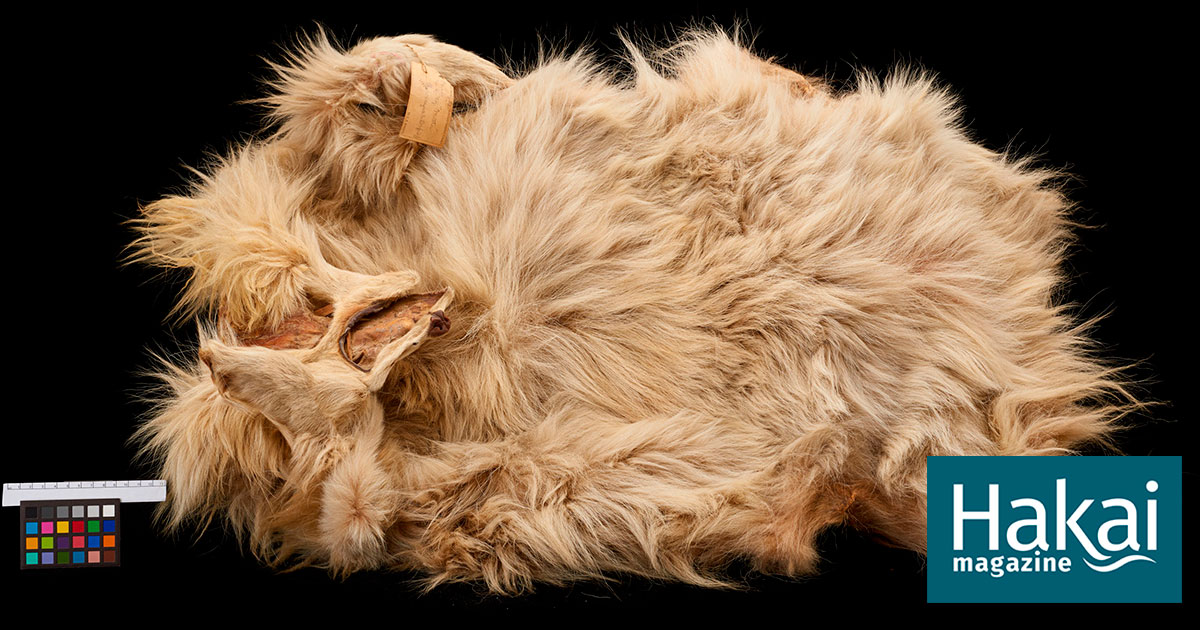
But to Lin, one detail in the story stood out above the rest: the tale of Mutton, a dog whose pelt, it turned out, had spent more than 160 years housed right where she worked.
Mutton was a spirited wooly dog with a unique history. He was likely born in the traditional territory of the Stó:lō Nation, what is now British Columbia’s Fraser Valley. In 1858, Mutton was adopted by George Gibbs, a naturalist and ethnologist working on the Northwest Boundary Survey, a British-American expedition to map the land border between Canada and the United States. Gibbs kept detailed field journals and notes about his adventures—including Mutton’s escapades, like the time the rascal chewed on the head of a scientifically important mountain goat specimen. The pair traveled together for about two years before Mutton fell ill and died. After he passed away, Mutton’s pelt and lower leg bones, along with Gibbs’s journals, found their way into the Smithsonian’s collections.
Reading the story, Lin was struck by curiosity: was Mutton a wool dog?
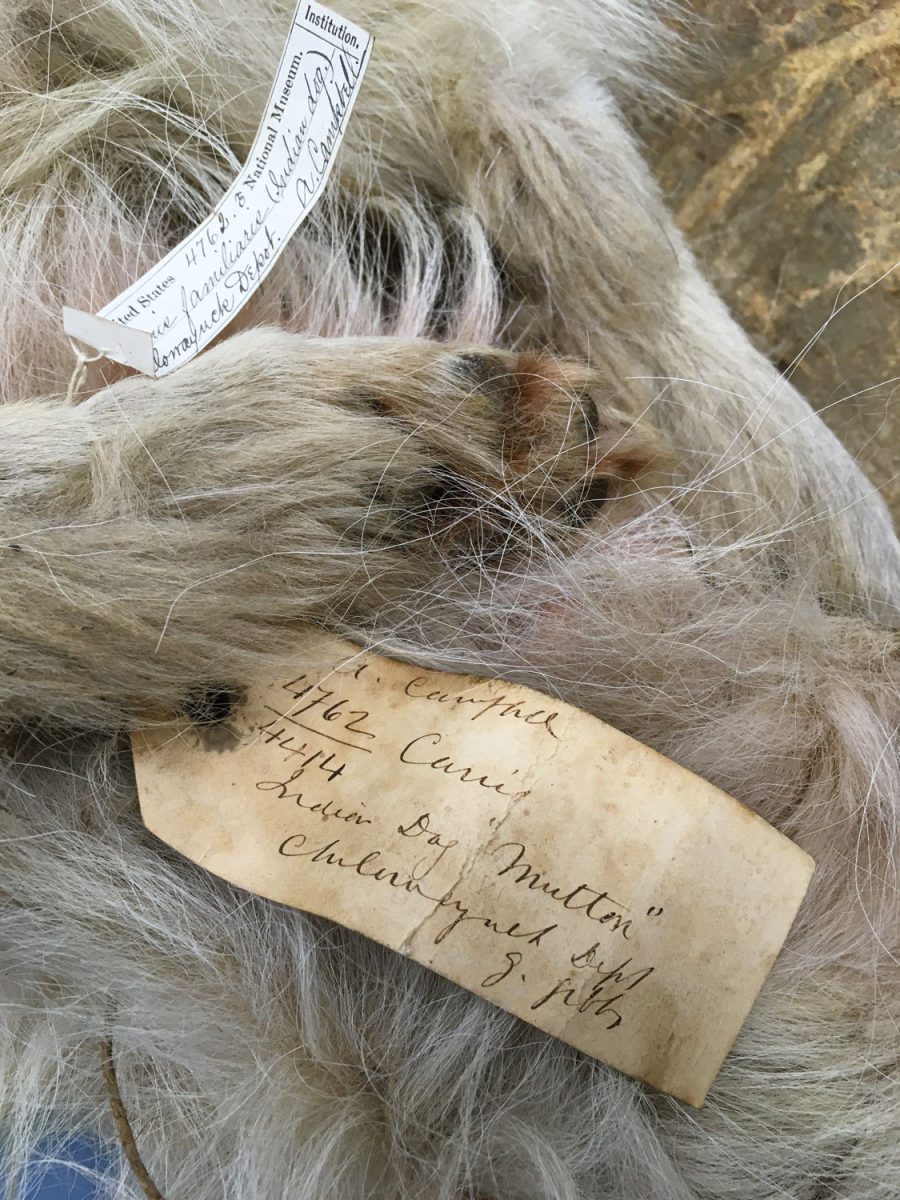
Molecular evolutionary biologist Audrey Lin and her colleagues hope the ancient genes of the wooly dog Mutton can answer questions about the diversity of dogs in the Pacific Northwest. Photo by Audrey Lin
European colonists had brought their own dogs to North America, and these introduced breeds eventually replaced the dogs already living on the continent, Lin says. Because Mutton was born decades after the introduction of settler breeds, Lin wondered if he was a pure Coast Salish wooly dog, mixed with a European breed, or something else entirely. Unlike most people reading the story, she knew exactly how to answer her own questions. She needed to sequence Mutton’s genome.
So Lin reached out to Logan Kistler, an anthropologist and the Smithsonian’s curator of archaeobotany and archaeogenomics. While Kistler also didn’t know much about wooly dogs, he was captivated by the idea that perhaps the only known specimen was sitting nearby.
Before taking samples from Mutton’s pelt and beginning their research, the pair secured permission from Steven Point, grand chief of the Stó:lō Nation on whose land the pup was likely born. Then, Kistler got to work sequencing Mutton’s DNA in the Smithsonian’s otherwise deserted ancient DNA lab, shuttered by the COVID-19 pandemic.
Comparing Mutton’s DNA to that of hundreds of other dog breeds, both modern and ancient, Lin and Kistler found that he was indeed a wooly dog. Or, rather, Mutton was about 84 percent wooly dog, and shared about 16 percent of his ancestry with European breeds, such as English cocker spaniel and Dalmatian.
Their genetic analyses also allowed them to identify 28 particular genes linked to hair and skin that seemed to have been positively selected for in Mutton’s ancestry through breeding. One gene, KANK2, is also linked to a wooly hair disorder in humans, while another, keratin 77, is associated with wooly hair in mice and mammoths. But by comparing Mutton’s genetics with those from a variety of modern canines, Lin and Kistler found the only hair-related gene he shared was one linked to long fur. It’s proof, says Kistler, that the wooliness of the Coast Salish wooly dog is unique.
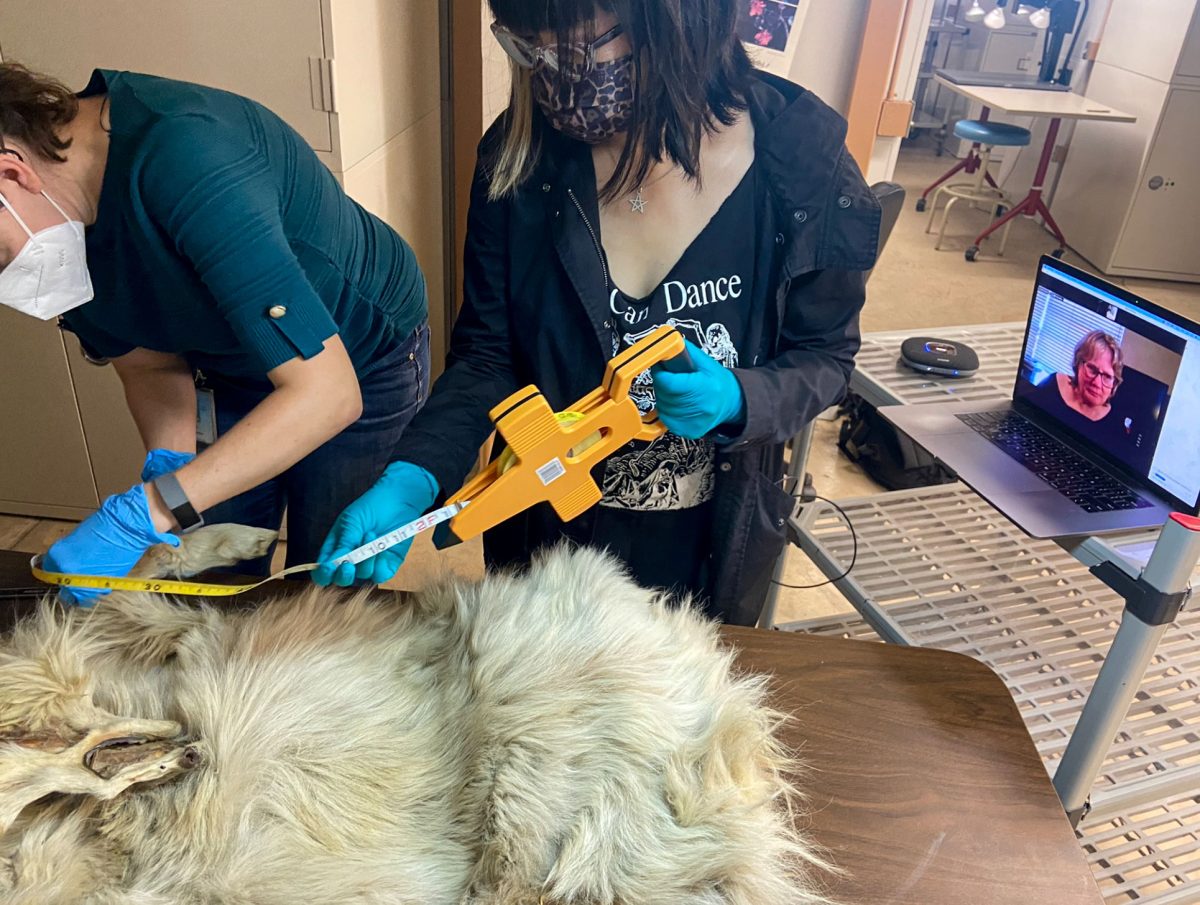
Having genetic proof that wooly dogs are a distinct breed native to the Pacific Northwest is exciting and validating, says Debra Sparrow, a master weaver from the Musqueam First Nation. But it’s also very tiresome, she says, having to continually prove her people’s stories through Western science. Photo courtesy of Audrey Lin
But Lin wanted to know more than just Mutton’s genetic history. So she also reached out to Liz Hammond-Kaarremaa, a researcher who studies Coast Salish spinning. Hammond-Kaarremaa assembled an advisory committee of Coast Salish elders and weavers from both sides of the US-Canada border and conducted interviews with folks who shared their own stories of wooly dogs and recounted those of their ancestors. From the grandfather who remembered wooly dog hair being valued like gold to the great-grandmother who kept wooly dogs but was forced by the colonial government to give them up, these ethnographic accounts add rich cultural context to the genetic research and wooly dogs themselves.
There was a long-held colonial belief that wooly dogs must have come from elsewhere—somewhere in Asia perhaps, Hammond-Kaarremaa explains. But this study, on which she was a coauthor, has helped Western scientists catch up to what Coast Salish people have always said: that they’d been caring for and breeding wooly dogs since at least 1,800 years ago, and possibly as far back as 4,000 to 5,000 years ago.
Debra Sparrow, a master weaver from the Musqueam First Nation and a coauthor on the study, says her grandfather, Chief Ed Sparrow, born in 1898, told her childhood stories about watching the women in his village go through the process of weaving blankets with wooly dog and mountain goat fur. He told her that “every village, anywhere on the coast here where Salish people are, had those little cuties being raised.” The women wove that fur into blankets—practical and symbolic objects that were essential in ceremonies and for teaching values. “Everything we did was based on those blankets,” Sparrow says.
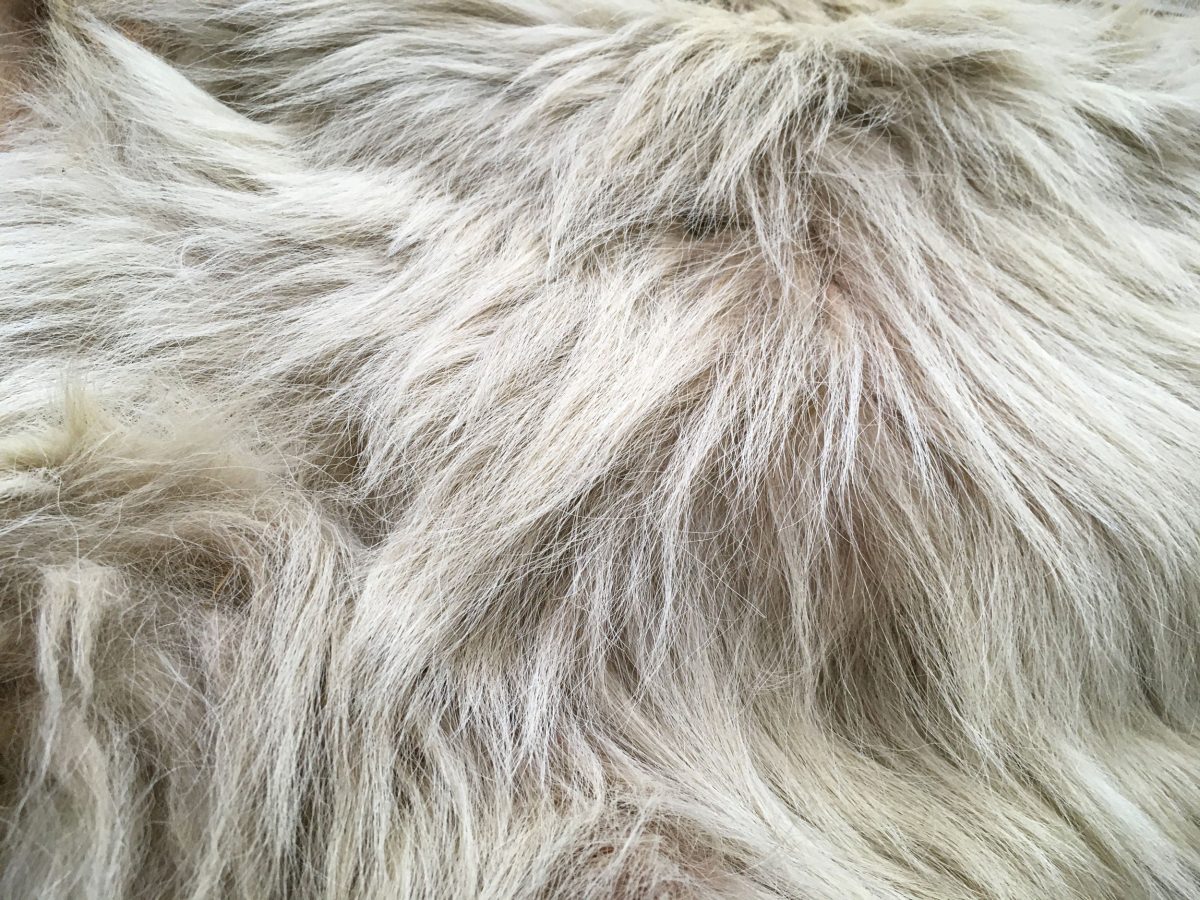
For Coast Salish people, the practice of weaving starts long before you even touch the wool, says Snumith’ye (Violet Elliott) a master weaver living in the traditional territory of the Cowichan Tribes. A weaver using wooly dog fur would express gratitude for the wool, pray, plan their patterns and materials, set intentions, and get into the right headspace before beginning, she explains. Photo by Audrey Lin
Mutton may have lived more than 160 years ago, but he’s still teaching us about wooly dogs, the role of fibers and textiles in Coast Salish culture, the solid understanding Indigenous people had of husbandry, and the women who cared for these dogs, Hammond-Kaarremaa says. “The story doesn’t end here. I think Mutton has opened up the doors.”
Iain McKechnie, coauthor and archaeologist at British Columbia’s University of Victoria and the Hakai Institute, says Mutton’s genome will be the key that unlocks the genetic history of wool dogs and the various subtypes that occur in the archaeological record.
Sparrow plans to bring traditional weaving into the modern age. In 2024, she will weave a blanket with modern dog hair, mountain goat wool, clay, and stinging nettle—the first in almost two centuries. She is honored to be bringing back this part of her culture that was lost to colonization. “I stand in my history, I stand in my culture, and the spirit of the wooly dog stands beside me,” Sparrow says.
Mutton may be close to standing by Sparrow and other Indigenous weavers in the near future as there are plans for the pup’s pelt to go on a regional tour of the Pacific Northwest, stopping at various museums and providing an opportunity for Coast Salish people to hold ceremonies.
The thought of Mutton’s return brings tears to the eyes of Snumith’ye (Violet Elliott), a master weaver with ties to Cowichan, Penelakut, Snuneymuxw, and Stz’uminus First Nations as well as ancestors from Hawai‘i and Portugal.
“I’m excited that the wooly dog is making a comeback,” Elliott says. “There’s so much about our history that is so sad and Mutton’s resurgence allows us to tell how we thrived as a people.” Elliott was on the advisory committee for the study and feels these findings are a gift to Coast Salish people. She wonders if the genetic sequence might provide a path toward breeding the wooly dogs once again.
But Elliott also says she feels sad because this research is a reminder that the breeding and care of wooly dogs, which had such great cultural and spiritual significance, was cut short. “Weaving didn’t go away … but that history about the wooly dog almost disappeared,” she says.
Mutton is making sure that doesn’t happen.
