


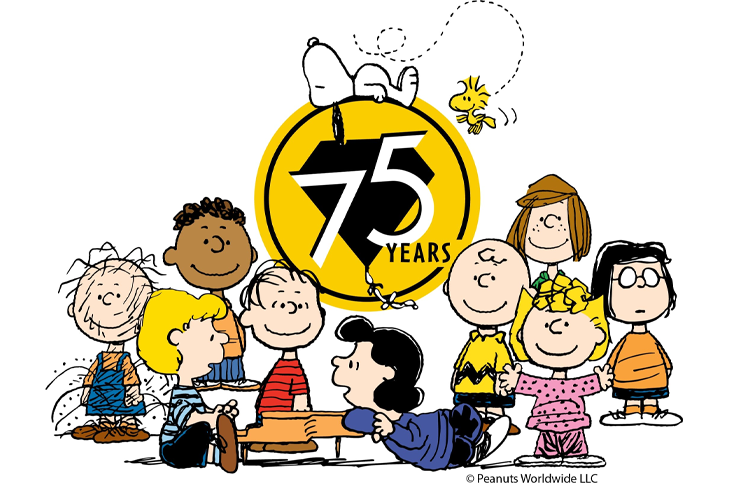
For over 70 years, Snoopy, the imaginative and good-natured Beagle from Charles M. Schulz’s beloved Peanuts comics, has captured the hearts of millions. Read on to learn more about the history of Snoopy and how he evolved from a silent, four-legged sidekick to the world-famous dog we know and love today.
Debut and Character Development
Snoopy made his debut on October 4, 1950, two days after the first Peanuts strip was published. Schulz modeled the character after his childhood mixed-breed dog “Spike,” who was also white with black ears and markings.
“Snoopy was only a cute little puppy who barked and frolicked, yet showed signs of a sly sense of humor. It wasn’t until the end of 1952 and the early part of 1953 that Snoopy regularly shared complete thoughts with readers,” says Benjamin L. Clark, Curator of the Charles M. Schulz Museum and Research Center.
As the 1950s progressed, Snoopy’s character expanded exponentially, with his playful imagination becoming the central theme of many comic strips. During this time, his outward appearance also changed, and he began to adopt different personas.
“When he was introduced in 1950, Snoopy was a little puppy, standing on all fours, barking, chasing cars, chasing birds, digging holes, and generally acting like a little dog,” Clark explains. “As the years go by, his appearance evolves, and he gets bigger, rounder, and more abstract. He maintains his distinct markings, but eventually walks on two legs regularly, wears human clothes sometimes, and goes on amazing adventures.”
Peanuts’ Rise in Popularity
“It was in the 1960s when Snoopy really came into his own and became the Beagle we all know and love. I think the very first fans would have been drawn to Snoopy simply because he was cute, but as time went on, he developed more personality, and readers would have connected with Snoopy in his more exciting aspects and funny quirks,” says Clark.
A series of television specials directed by Bill Melendez was a significant factor in Snoopy’s rise. Melendez voiced the character in “A Charlie Brown Christmas” (1965) and “It’s the Great Pumpkin, Charlie Brown” (1966), which introduced Snoopy to a new audience and remains a beloved part of many families’ holiday traditions to this day.
Snoopy also made his first appearance in the Macy’s Thanksgiving Day Parade in 1968, with a balloon depicting him as the Flying Ace. Nearly 60 years later, Snoopy has been in almost every parade since.
Woodstock, Snoopy’s best friend who happens to be a small yellow bird, first appeared in the comics in 1966, though as an unnamed character. He was given his name in 1970, which Schulz says was inspired by the music festival of the same name, and made his on-screen debut in the film “Snoopy Come Home” in 1972.
By the 1970s, Peanuts had become a complete sensation, ranking as one of the world’s most popular comic strips. You could find Charlie Brown, Snoopy, and the rest of the Peanuts gang on merchandise and products ranging from toys to lunchboxes to apparel.
The Flying Ace and Collaborations With NASA
Snoopy was first seen as the World War I Flying Ace in 1965, and in the decades since, it’s become one of his most recognizable personas.
“Schulz’s son, Monte, was working on plastic World War I airplane models, and came into the studio to show his dad his latest efforts. Schulz was working and doodled a picture of Snoopy atop his doghouse wearing the classic leather flight helmet of that era,” Clark says of the character’s origins.
Schulz was committed to ensuring factual accuracy within his comic strips and researched all aspects of World War I when creating this character. He was also inspired by adventure serials he saw at movie theaters growing up, as well as the resurgence of aviation war films released during the 60s.
During this time, Schulz also became involved with NASA, which requested to use the Peanuts characters to boost morale and visibility. Snoopy became a mascot for NASA’s Manned Flight Awareness program in 1968. A year later, the Apollo 10 crew chose to nickname their command and lunar modules Charlie Brown and Snoopy, respectively.
This partnership continues to this day, with the Silver Snoopy Award still serving as an honor for members of the NASA workforce. Astronauts award this prize to individuals who’ve made valuable contributions to supporting safe spaceflights. Each year, less than 1% of the aerospace program workforce receives the award, which comes with a sterling silver Snoopy lapel pin that has flown in space.
Snoopy’s Legacy and Lasting Appeal
For nearly 50 years, Schulz drew every comic strip himself, with over 17,000 editions published. The final daily Peanuts strip was published on January 3, 2000, and featured a drawing of Snoopy sitting atop his doghouse, typing on his typewriter. Alongside the drawing was a note from Schulz, announcing his retirement from producing the comics and expressing his gratitude to his editors and readers for their support.
He died just over a month later on February 12, 2000, at the age of 77. At the time of his death, the Peanuts comics had more than 355 million readers worldwide, and were published in 75 countries, 2,600 papers, and 21 languages every day.
In 2015, Snoopy received a star on the Hollywood Walk of Fame, becoming the first Beagle to receive this great honor. It’s located next to the star in honor of Schulz, whose son was present at the unveiling ceremony.
Twenty-five years after Schulz’s death, Snoopy continues to entertain and inspire through animated series and films, as well as new generations’ take on the character through social media, fashion, and more.
