


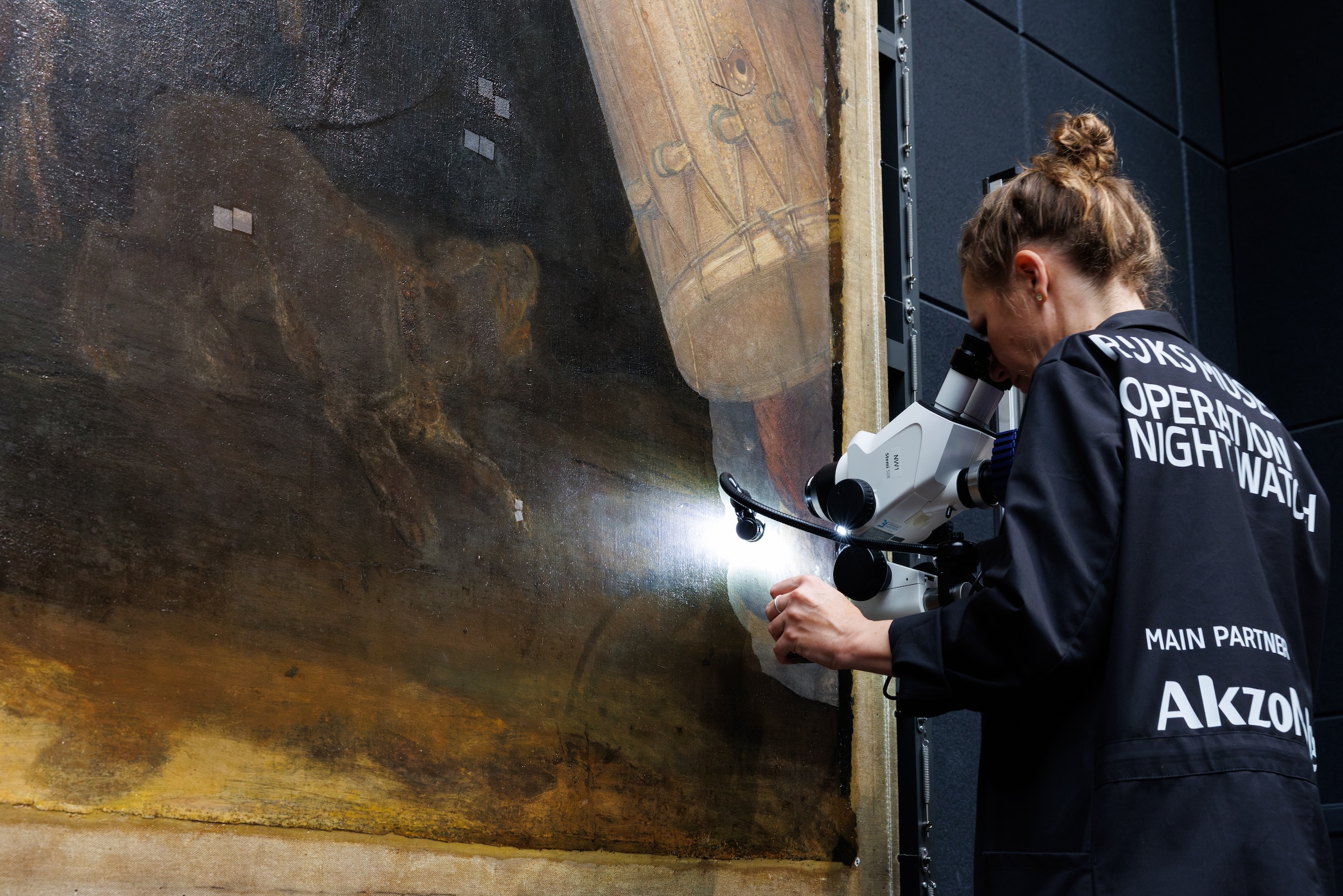
When Rembrandt van Rijn (1606–1669) was creating his great 1642 masterpiece The Night Watch, he looked to an earlier drawing by Adriaen van de Venne (1590–1662) to model the complex composition’s barking dog. The previously unknown origins of The Night Watch dog were discovered thanks to “Operation Night Watch,” an in-depth restoration and study of the work that has been underway at the Rijksmuseum in Amsterdam since 2019.
Remarkably, the two artworks have both been in the Rijksmuseum collection for over a century, but this is the first time the similarity between the two dogs has been formally noted—understandable, given the busyness of the scene and the dark shadows obscuring the animal from view. Anne Lenders, curator of “Operation Night Watch,” was the one who saw the 1619 Van de Venne drawing in an exhibition at the Zeeuws Museum in Middelburg, the Netherlands, and immediately clocked the likeness.
“When I saw the drawing,” she said in a statement, “I immediately thought of the dog in The Night Watch. The dog’s head, collar, and pose have such a strong resemblance that it can only mean Rembrandt used this drawing as a source of inspiration. The follow-up research has confirmed this.”
Both the painting and the drawing show a small dog looking upward in the same direction. Their ringed collars match closely, and their heads, which have the same shape, are tilted in identical rotation, with a dark line marking the right eye. In both works, the dog sits on a diagonal, in a similar pose.
A Watershed Moment in Art History
Rembrandt broke new ground with The Night Watch, which wasn’t a religious scene, a history painting, or a portrait of a noble or royal patron. Instead, it was scene of contemporary life, commissioned by members of Amsterdam’s civic guard to show the company at the ready, symbolizing national pride. (The full title is technically Militia Company of District II under the Command of Captain Frans Banninck Cocq.)
But Rembrandt was also a student of art history, at a time when plagiarism as we know it today did not exist. Art historians have previously identified figures in The Night Watch where Rembrandt cribbed the poses from others’ artworks.
Rembrandt van Rijn, The Night Watch (1642). Collection of the Rijksmuseum, Amsterdam.
“You see that in Italian treatises on painting in the 16th century, it really was the intention that you as a starting artist would copy a lot, make it your own, so that you could improve on it and continue the work another artist had left behind,” Rijksmuseum director Taco Dibbits told the Guardian. “It was called emulation.”
Van de Venne was a successful artist and illustrator, as well as a poet and publisher. Rembrandt copied his dog, seen next to the drum at the bottom right, from a detail of a drawing that was the title page for Jacob Cats’s 1620 book Self-stryt, dat is, Krachtighe beweginghe van Vlees ende Gheest (Self-Conflict, or, The Powerful Motions Between the Flesh and Spirit). It illustrates a scene from the biblical story of Joseph, when he was tempted by Potiphar’s wife.

Adriaen Pietersz van de Venne, Frontispiece Design for Jacob Cats, Self-Strijt (1619), showing Joseph being tempted by Potiphar’s wife. Collection of the Rijksmuseum, Amsterdam.
The Night Watch is not the only Rembrandt work that appears to have pulled from the Van de Venne drawing. Rembrandt’s 1655 painting of the same subject, Joseph Accused by Potiphar’s Wife, shows Joseph in a similar pose, gazing upward with his palm raised up. And the painting features bedding similar to that in the background of Van de Venne’s work.
It is unclear how Rembrandt became familiar with the drawing, but the book was a popular one, and Rembrandt had an enormous collection of other artists’ prints and drawings that he used to inform his work.

Rembrandt van Rijn, Joseph Accused by Potiphar’s Wife (1655). Collection of the Gemäldegalerie Berlin.
The Restoration Work Is Underway
“Operation Night Watch” has also unveiled Rembrandt’s original sketch for the work through MA-XRF (macro X-ray fluorescence) analysis. The museum revealed what it dubbed a “calcium map” of the painting in 2021, allowing the world to see the changes that the artist made to the composition as he worked.
In Rembrandt’s preparatory drawing, he copied Van de Venne’s dog even more closely than in the finished work. Instead of painting the dog standing on all fours, Rembrandt originally depicted the animal crouching closer to the ground, resting on its front legs.

Adriaen Pietersz van de Venne, detail of a dog from Frontispiece Design for Jacob Cats, Self-Strijt (1619), compared to the dog in Rembrandt van Rijn’s The Night Watch (1642) as seen in the finished painting and the underdrawing. Photo: courtesy of the Rijksmuseum, Amsterdam.
Rembrandt did put his own spin on the pooch, however, by painting the animal with his tongue hanging out, and slightly longer ears. His dog is also a little fatter than the one in the Van de Venne composition, with its tail between its legs. The Rijksmuseum team was unable to determine which breed of dog the artists were depicting. It could be an ancestor of a short-legged hunting dog known as the basset fauve de Bretagne, or a Dutch or French breed from the time.
“We will never have a conclusion on which breed it is,” Dibbits told the Associated Press. “But it’s definitely very much loved.”
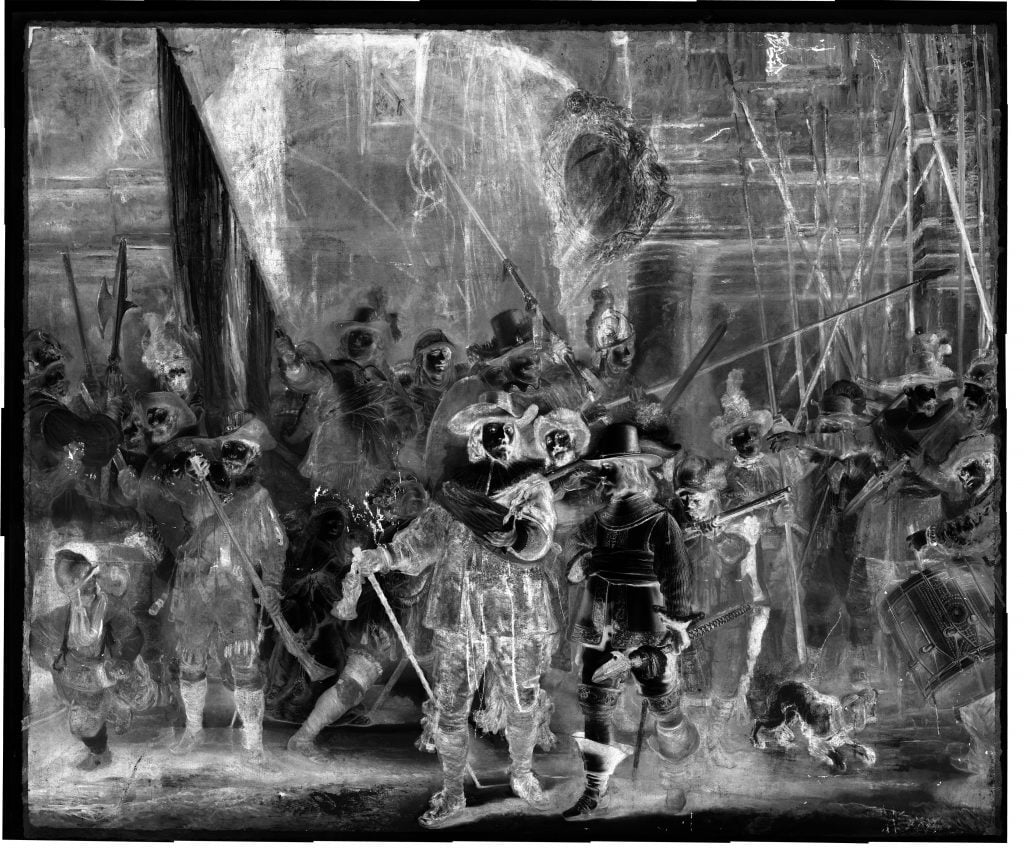
The calcium map of Rembrandt van Rijn’s The Night Watch. Photo: courtesy of the Rijksmuseum.
Unlike most restoration projects, “Operation Night Watch” is being conducted entirely inside the galleries in full view of visitors, the work made possible thanks to a specially designed glass chamber.
The painting sits at the heart of the museum’s “Gallery of Honour,” a long, richly decorated second-story corridor that houses the collection’s 17th-century masterpieces, and this is the first time it’s undergone conservation since repairs following a 1975 breadknife attack by a disgruntled museumgoer.

“Operation Night Watch” curator Anne Lenders in front of the massive Rembrandt van Rijn painting with the drawing by Adriaen van de Venne that inspired the dog in the The Night Watch. Photo: courtesy of the Rijksmuseum, Amsterdam.
The restoration project has become the largest and most comprehensive study of the famed painting, with the art historical research yielding fascinating new details. In the work’s second phase, conservators are currently working to remove varnish from the delicate canvas.
That should make it easier to see the dog—one of the more badly deteriorated areas of the painting, partially obscured by a whitish haze due to Rembrandt’s chalk underdrawing shining through the paint—more clearly.
“The dog plays a really crucial role because the captain is giving the command that the company has to start marching. The drummer beats his drum, and the dog reacts and starts barking. So you really have this suggestion of noise and movement,” Lenders told the London Times. “The dog really heightens the liveliness of the painting and the drama.”
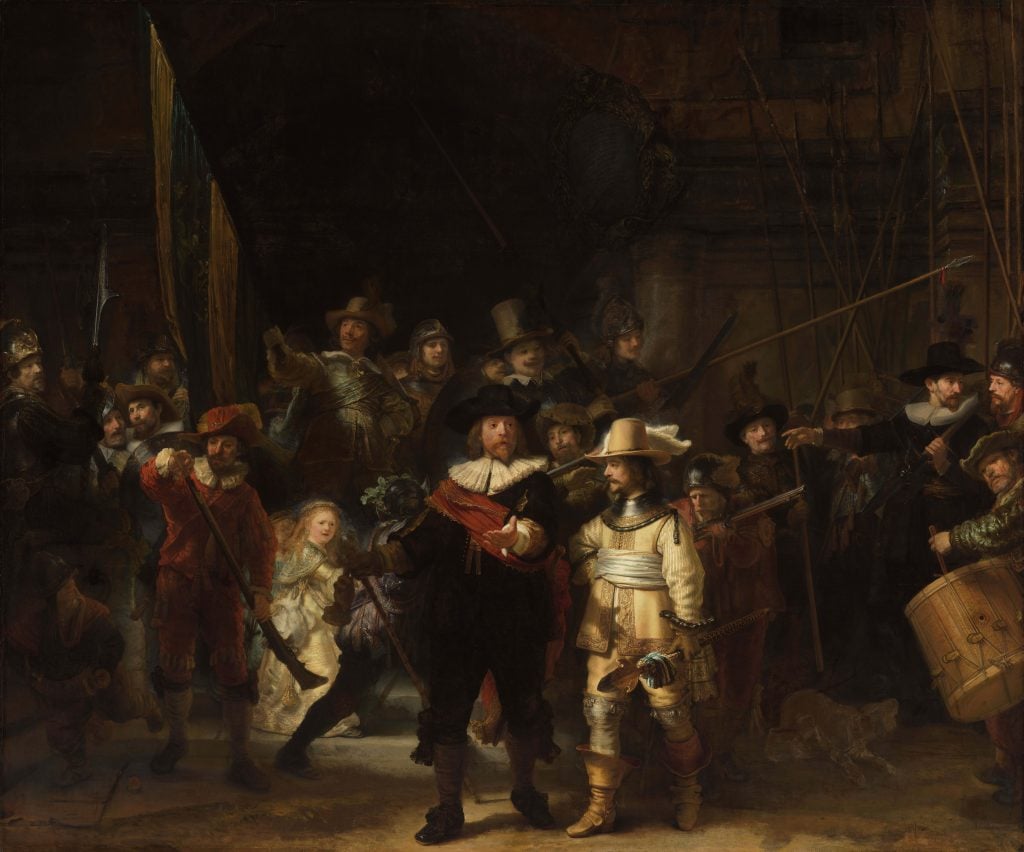
Rembrandt van Rijn, The Night Watch (1642). Collection of the Rijksmuseum, Amsterdam.
Since work began, “Operation Night Watch” has also identified traces of egg yolk and arsenic in the painting, as well as a base layer of lead. Experts were even able to use A.I. to reconstruct long-lost portions of the painting, trimmed off for its display at Amsterdam’s Town Hall in 1715. The realization surrounding The Night Watch dog is the subject of the first video in a six-part YouTube series, “The Night Watch: Every Inch a Story.”
“It is remarkable that new discoveries are still being made about one of the most studied paintings in the world, almost 400 years after it was made,” Dibbits said in a statement. “This finding gives us yet more insight into Rembrandt’s thought processes when creating this work.”
