


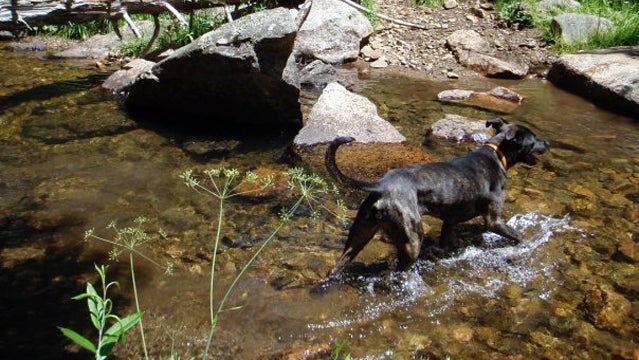
I’ve never been sure about what breed my two raucous dogs are. I’ve been close to sure. I’ve had veterinarians make suggestions and the dog-obsessed hint at a trace of this or that breed, but every time I almost have it nailed down, someone tells me otherwise or the dog pulls a stunt I’ve never seen. For instance, my mostly-black brindle dog, Odin, is quite possibly 90 percent pit bull. The shelter “sold” him to us as a lab mix, of course, but there’s no questioning his box-shaped melon and the marble-like coloring of his fur. Until, that is, we were out hiking and came across a scattered group of cattle. Never before have I seen him round up cattle. All it took was some high-pitched barking and nipping at their heels and he had them in a small herd in the corner of the field. Um, border collie? Australian shepherd? General nuisance?
The Ultimate Adventure Companion
All you need to know about going wild with man’s best friend.
 Rio, 2 1/2.
I don’t know why I’m so eager to find out what breeds actually inhabit their floppy ears and droopy eyes. It won’t change anything. They’ll still be the same pooches that they’ve always been. But knowing that there is a test out there that can reveal this piece of information makes me curious. When I first came across the Canine Heritage Breed Test, the process that is able to break down a dogs DNA to find its primary, secondary, and tertiary breeds, the company was only able to define roughly 68 breeds. That may sound like a lot but, when it comes to the hundreds of dog breeds that exist, that’s just a pinprick in what should be a gaping hole. I was further deterred because someone had suggested my red dog, Rio, is part saluki—the oldest domesticated dog known to man—and that breed (which I’d never even heard of) did not grace the Canine Heritage Breed Test’s list.
Today, however, the test is able to detect over 100 breeds, including said saluki as well as other rarities like wirehaired pointing griffon, a hunting dog that resembles an even longer-haired version of a wirehaired German pointer, or keeshonden, what looks like a mix between a chow chow and an Alaskan malamute. One hundred breeds is definitely not the gamut but saluki now exists on their list, so I figured that was my cue. At first, I questioned the validity of it, but then I came across this:
The Canine Heritage Breed Test began with the search for a set of unique DNA markers, known as SNPs (Single Nucleotide Polymorphisms), which could identify the breed of a purebred dog. We started by testing over 400 different DNA markers on over 100 [AKC-recognized] purebred breeds to identify the unique combination of markers that describe each breed. After testing thousands of purebred dogs, a unique breed DNA profile was developed using over 400 DNA markers per breed. From these initial markers we identified a smaller subset of markers used for the Canine Heritage Breed Test. This final marker set, based on a blind study using thousands of dogs that have been verified to be purebred by AKC certification, was able to successfully assign the correct breed over 99 percent of the time when testing purebred dogs that are among our identifiable breeds. These markers were then applied and validated on mixed breed dog populations.
How it works: You order a test kit from canineheritage.com ($120), which includes a cheek swab brush which you’ll use to collect cells from the inside of your dog’s cheek. You stick the swab into the data collection envelope they send, stamp it, mail it, and sit back for four to six weeks twiddling your thumbs. Collecting the cells is easier than you think. It’s simply like brushing the inside of the dog’s cheek for 30 seconds with what looks like a mascara brush.
When submitting the test, they ask for a voluntary photograph of your dog. I opted not to send one. While I’m sure the labs at the testing facility aren’t cooing at dog photos and going, “I don’t know, he looks more cocker spaniel than miniature pinscher,” I didn’t want to sway them one way or the other.
Give it your best shot. What breed do you think my dogs are? Find out the results in our next dog post.
This article originally appeared on Outside K9, the former dog blog of Outside magazine, on November 2, 2009.
