


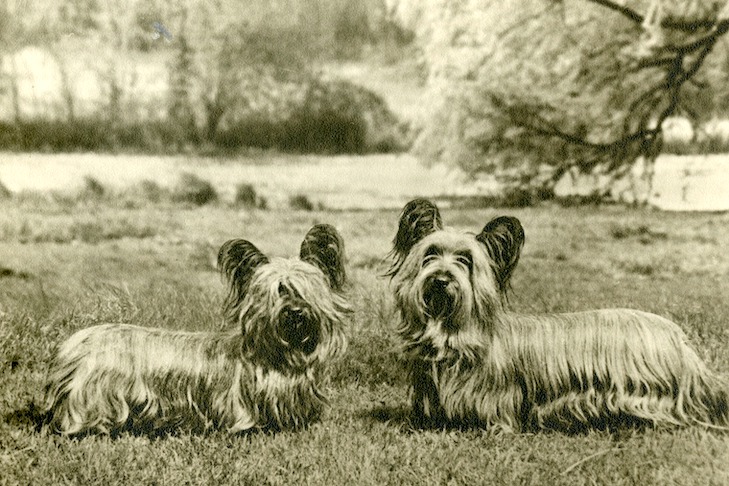
The craggy, beautiful Isle of Skye, off the northwest coast of Scotland, gave rise more than 400 years ago to the rugged yet elegant terrier that bears its name. With a form that has remained essentially unchanged over the centuries, the Skye Terrier today is still the good-natured, loyal, fearless companion that ferreted vermin out of the rocks and lairs of its island home and charmed the English nobility of the 19th century as a fashionable pet.
English artist Alexander Davis Cooper has shown two Skye Terriers, silhouetted by a wonderfully atmospheric landscape, in the painting, On the Isle of Skye, given to the AKC Museum of the Dog by the estate of George D. Cornell.
Farmers in the 1600s bred Skye Terriers. They trained these dogs to protect their farms from animals like foxes, badgers, and otters. The Skye’s long, thick coat made them appear larger and more threatening, and protected them from bites. Unlike many other Terrier breeds, the Skye Terrier has had the same appearance for at least the last four centuries.
Cairn Crossing?
“On the Isle of Skye is a charming portrait of two Skye terriers that surely were not show dogs,” said Walter F. Goodman, who served as an AKC judge for over 30 years and was a member of the Board of Directors of both the American Kennel Club and the AKC Museum of the Dog. “They were working dogs at this point in the 19th century, used by their owners to go to ground, to capture vermin, badgers, and even wily foxes in their lairs.”
“I feel certain that on the Isle of Skye, at some juncture, there was crossbreeding between the Skye and his later recognized cousin, the Cairn Terrier,” observed Goodman, who bred 36 Skye champions and was a past president of the Skye Terrier Club. “Consequently, the two Skyes represented by Alexander Davis Cooper are this type. The Skye on the left is a true drop-ear. The fawn prick-ear on the right, with his one drop ear and short foreface, could have some Cairn [in its background]. While their long bodies mirror today’s Skyes, their long legs do not. Perhaps being higher stationed better suited them to cover the rough terrain on the Isle and elsewhere in the rugged highlands of Scotland.”
This Breed Amused Queen Victoria
With a long, silky coat covering its face and body, the Skye’s appearance is distinctive among terriers. Dr. John Caius, master of Gonville and Caius College, Cambridge University, and court physician to Edward VI, Queen Mary Tudor, and Queen Elizabeth I, mentioned Skyes in his historic work, “OfEnglisheDogges,” in the mid-16th century. Their keen sense of smell made them good hunters. Plus, their dense coats protected against animal bites and harsh weather.
The dog’s stylish appearance found favor with English nobility as early as the time of Caius. However, it was Queen Victoria’s great fondness for the breed that made Skye Terriers fashionable pets.
“Queen Victoria and Prince Albert’s ownership of the Skye Terrier in the mid-to-late 19th century heightened the public’s infatuation with the breed, and its popularity rose,” says Goodman. “One of Queen Victoria’s Skyes was even exhibited. Between 1860 and 1870, George Earl, the well-known dog painter and father of the even better-known dog artist, Maud Earl, painted a series of British and Scottish dogs. Among them was Rook, the first Skye terrier champion recorded by The Kennel Club [England], owned by the Reverend MacDonna.”
The motto of the Skye Terrier Club of Scotland is “Wha daur meddle wi’ me.” In English, this translates to “No one meddles with me with impunity.” This sentiment aptly reflects the ongoing reluctance of Skye fanciers to change the breed’s centuries-old form. The Skye’s days of dispatching fox and badger are largely in the past. But the farmers of Scotland’s northwestern islands who developed the breed would certainly recognize the staunch working terrier in today’s elegant Skye.
Skye Terriers Today
Though the Skye Terrier was immensely popular in the Victorian Era, their numbers have declined dramatically. Just 42 were registered with the UK Kennel Club in 2012, and the breed ranks 185 out of 201 AKC-recognized breeds, as of 2024. Even though their numbers are small, Skyes continue to compete in shows as formidable competitors. In 2014, a Skye Terrier named Charlie won Best In Show at the AKC National Championship.
