


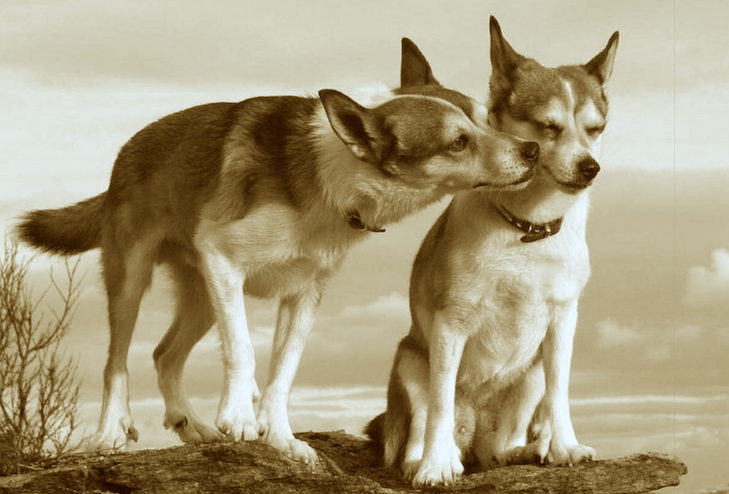
According to 2021 registration statistics, the Norwegian Lundehund is the rarest and least popular dog breed, ranking 197 of 197 breeds. But there’s still a hole lot to love about this dog.
A dozen or so years ago, potty-mouthed TV chef Gordon Ramsay visited Iceland for his first taste of puffin.
With its orange beak and tuxedoed body, the puffin resembles a sort of airborne penguin. But despite its cartoonishly charming appearance, this seabird has been on the menu in Iceland and parts of Norway for centuries.
“Very creamy, slightly gamey, a little bit salty,” Ramsay said approvingly, poking around a fresh salad garnished with occasional slivers of smoked puffin. “Never tasted anything like it before — and obviously a [bleeping] nightmare to catch because there’s hardly any on my [bleeping] plate.”
Iceland has the world’s largest breeding colony of puffins, and birds there are still hunted by “skyfishing” — netted in mid-flight with what Ramsay described as “a pole vault with a net on the end.” In Norway, puffin hunting was traditionally centered on the Lofoten Islands, a remote archipelago north of the Arctic Circle whose average temperatures miraculously remain above freezing year-round due to the warming waters of the Gulf Stream.
Today, Norway has outlawed puffin hunting. But centuries ago, before nets began to be used, a special dog was developed to capture the brightly beaked birds.
The Rare Puffin Dog
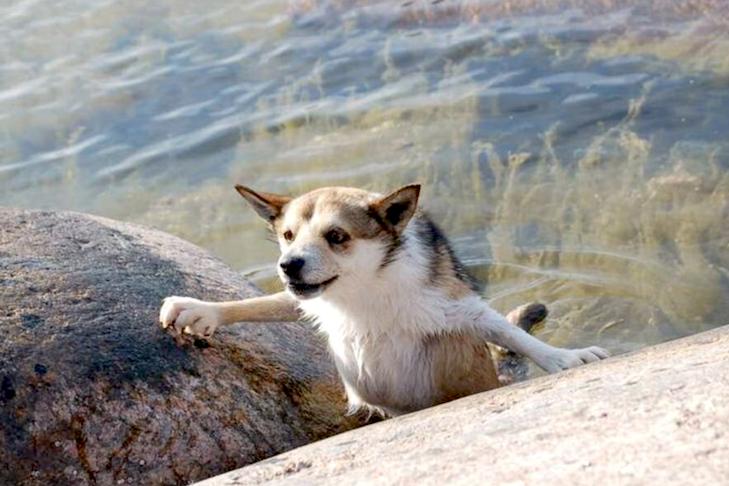
One of the rarest canines on the planet, ranking 197 among 197 AKC-recognized dog breeds, the Norwegian Lundehund – literally, “puffin dog” – would scale sheer-faced cliffs to raid puffin nests, bringing the still-live birds back to their masters.
No one knows quite how long Lundehunds have been living in this remote corner of Norway, but written records date back to the early 1400s. Households often had as many as a dozen Lundehunds, which were considered more valuable than a cow. The best dogs caught up to 80 birds a day, and nothing went to waste: Whatever fresh meat that couldn’t be consumed was salted in huge barrels for sustenance over the long winters. Puffin down was used in quilts and pillows, and anything left over was fed to the dogs.
The puffins, understandably, didn’t capitulate without a fight, as Ramsay learned all too well: His attempt at kissing a puffin he netted before releasing it earned him a gash that required three stitches.
The Lundehund, for its part, not only had to contend with beak and talon, but also with the narrow sea caves in which the birds nest. Crawling and twisting through those rocky crevices and tunnels required the canine version of a contortionist. As a result, the Lundehund can bend his head back so far that the top of his skull touches his spine, allowing for quick about-faces inside a cramped space. Thanks to an impressively flexible shoulder, he can also extend his legs out to the side, like the wings of an airplane, presumably to help stop him from falling after a misstep on the perilously high cliffs. And Lundehunds have the ability to tightly fold their ears to prevent water and debris from entering.
Finally, the Lundehund is a polydactyl. That’s not something you’d find roaming around Jurassic Park, but rather the formal name for the phenomenon of having extra digits, like Ernest Hemingway’s famous multi-toed cats that still reside at his Key West home.
Several breeds, such as the Great Pyrenees and the Beauceron, are required to have double dewclaws on each rear leg, but the Lundehund has extra digits on all four. Each of the Lundehund’s feet has at least six fully developed toes — compared to the five on the front feet (including the dewclaw) and the four on the back in most other breeds – giving them a kind of snowshoe appearance. This uniquely shaped foot helped the vertically oriented dogs grip the slippery cliffs and aided in digging in sea caves to locate puffin nests.
The Brink of Extinction
As the milkmen and lamplighters of previous centuries learned, the introduction of new technology often spells the death of traditional but labor-intensive livelihoods. And just like that, when hand-held nets became an easy and fast way to catch puffins, the highly specialized Lundehund became profoundly obsolete.
By the 1930s, the already rare Lundehund was hovering on the brink of extinction, surviving mostly in the village of Mastad on the island of Værøy. Around that time, an intrepid English Setter breeder named Eleanor Christie read about the breed in a magazine article. Intrigued – and persistent – she obtained breeding stock from Mastad and founded the Luxor kennel, which at its peak had more than 60 Lundehunds.
The survival of the Lundehund, however, proved as precipitous as the rocky cliffs it was bred to climb. A distemper outbreak during World War II wiped out almost all the dogs on Værøy, and Christie sent dogs back to the island to help repopulate it. Only a handful of years later, the same disease leveled her kennel, and Værøy reciprocated, sending her breeding stock.
Despite all this effort, by the 1960s only six purebred Lundehunds remained in Norway, and every Lundehund today descends from four of these dogs, all of which were related. While awareness of the breed grew slowly but consistently in the ensuing decades, the genetic bottleneck caused by this small gene pool was – and is – an ongoing concern. Among the issues are low fertility and a digestive disorder called intestinal lymphangiectasia, which inhibits the ability to absorb nutrients from food.
Adapting and Surviving
To add some much-needed genetic diversity to the Lundehund, Norway’s Lundehund club, in conjunction with the Norwegian Kennel Club and other national groups, has initiated an outcross project. Females from three other spitz breeds that are in geographic proximity to the Lundehund – the Norwegian Buhund, Icelandic Sheepdog, and Norrbottenspets – are being bred to Lundehund males. Ensuing generations will be crossed back to Lundehunds until they again resemble their paternal forebearers.
Lundehunds have also started to migrate their special skills to other purposes. The dogs are now being used at an airport in northern Norway where bird strikes, or avian collisions with aircrafts, are becoming an increasing problem. The Lundehunds find the seagull nests and remove the eggs, just as they did with their puffin counterparts for centuries.
Adaption, after all, is the antidote to extinction.
