


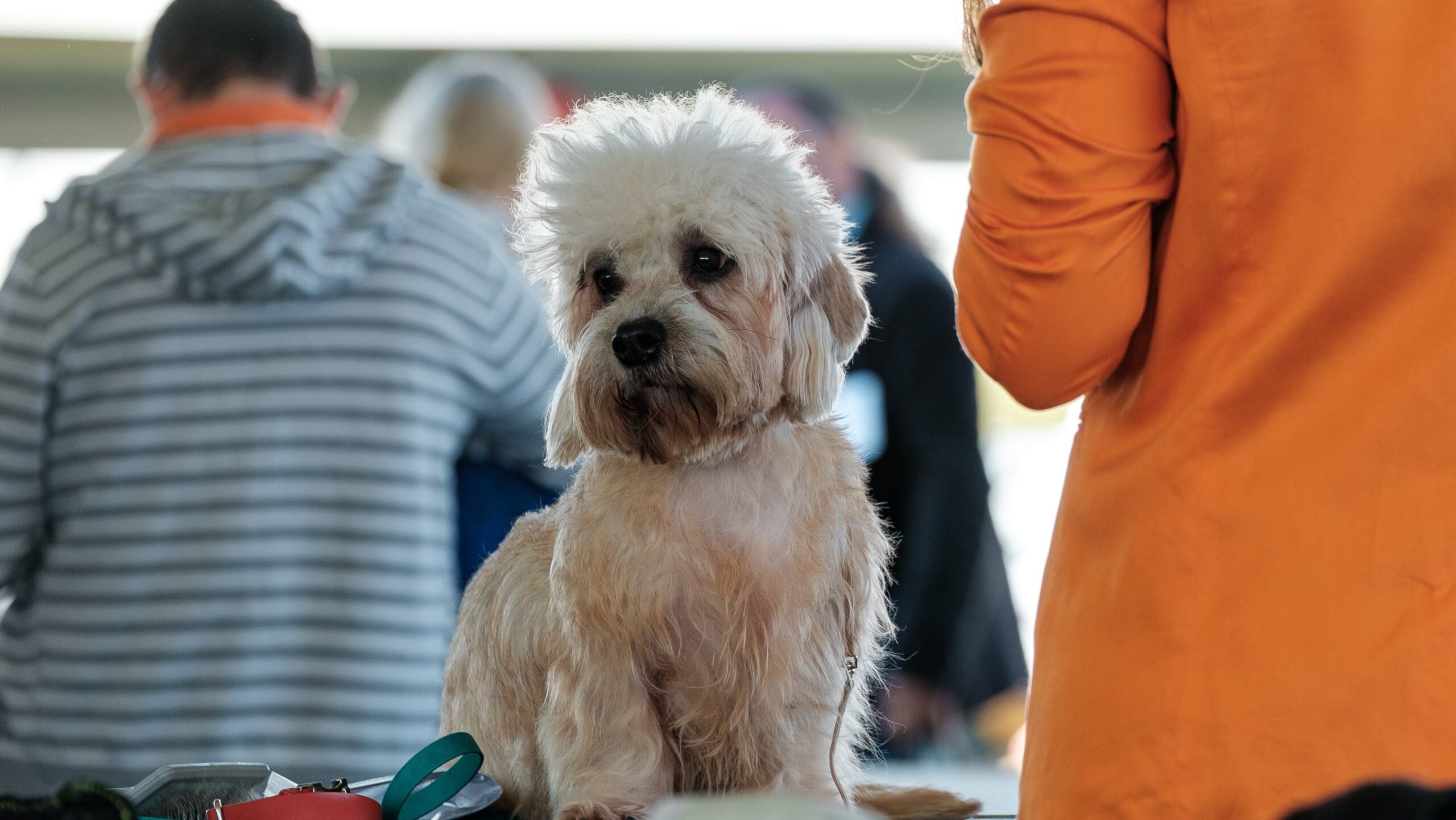
Recently, the Dandie Dinmont Terrier appeared at the American National Dog Show, which sparked a lot of public discussion about the breed. Get to know it too!
The National Dog Show is an American dog show held every November with the approval of the American Kennel Club (AKC) and the Philadelphia Kennel Club. The 2025 show was not the first time the Dandie Dinmont Terrier appeared in the ring, but for some reason, it had a greater impact on viewers this year than before. No wonder, as its unique, charming appearance is hard to forget. In response to its sudden fame, we have also brought you some interesting facts about this special terrier.
Interesting facts about the Dandie Dinmont Terrier
An especially rare breed
According to most sources, only about 300 Dandie Dinmont Terrier puppies are born each year worldwide, so the breed is not exactly an everyday sight. It is therefore completely understandable that its appearance at the show caused quite a stir.
World War II had a particularly negative impact on the breed’s numbers, but even before that, the Dandie Dinmont Terrier population was already in decline. In the 19th century, a breeder named Eaglesfield Bradshaw-Smith devoted a great deal of energy to maintaining the breed, and when “blood renewal” was needed, he used extreme methods to ensure that dogs with the best possible characteristics were included in the breeding stock.
Pepper-colored Dandie Dinmont Terrier
The Dandie Dinmont Terrier was originally bred for otter and badger hunting in the border region between Scotland and England, and Bradshaw-Smith placed great emphasis on his dogs’ hunting abilities – the dogs had to prove their aptitude against two badgers at once. His breeding program reportedly lasted from 1841 to 1882 and proved to be very important for the survival of the breed.
It was named after a character in a novel – but that’s not all!
Sir Walter Scott first published his novel Guy Mannering anonymously in 1815, featuring the character Dandie Dinmont. In the story, Dandie Dinmont was a farmer who kept six dogs, which he named Auld Pepper, Auld Mustard, Young Pepper, Young Mustard, Little Pepper, and Little Mustard. The names “pepper” and “mustard” refer to the dogs’ colors: these two color variations are still recognized today.
It was no coincidence that Sir Walter Scott named the dogs this way – he modeled the character of Dandie Dinmont on James Davidson, who is considered the creator of the modern breed. Scott first heard about James Davidson in Selkirkshire, as the writer was the sheriff of the county at the time. He was captivated by the farmer’s character, including his strange sense of humor, which was evident in the fact that his nearly 20 “pepper and mustard” terriers shared only two names. Davidson thus served as inspiration for the creation of the character of Dandie Dinmont in many ways.

Mustard-colored Dandie Dinmont Terrier
After the book was published, there was a huge demand for Davidson’s dogs, which had previously been known mainly in the local area. The farmer himself was quite proud of the mention, and although he reportedly never read the work, he quickly accepted that his dogs were called Dandie Dinmont’s terriers—later, the possessive ‘s’ was dropped, and the name Dandie Dinmont terrier, the breed’s current name, remained. Although Sir Walter Scott mainly kept Scottish Deerhounds, he did not object when Davidson gave him two terriers, “Ginger” and “Spice.”
The Dandie Dinmont Terrier therefore has a very interesting history, and today it is becoming increasingly well known—and hopefully it will remain so.
