


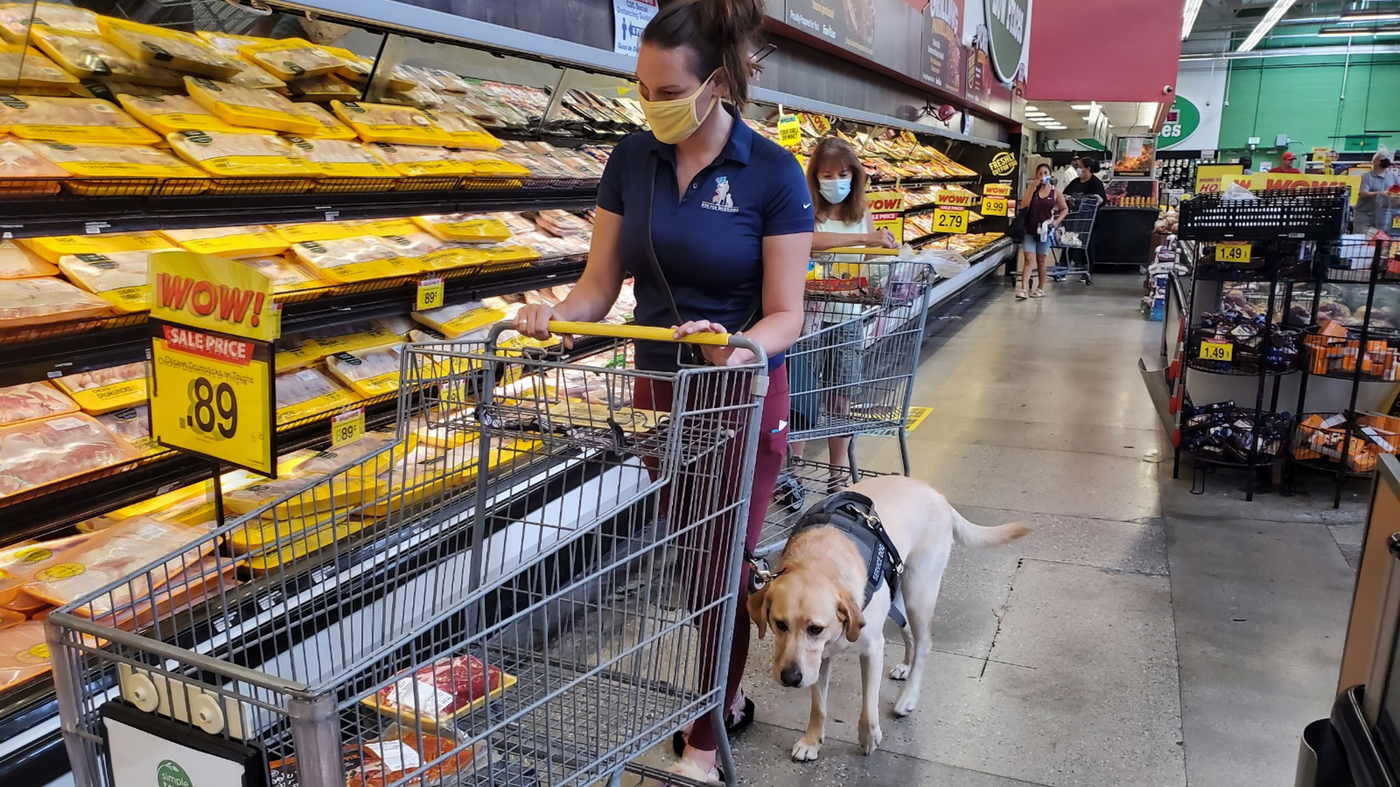
Danyelle Clark-Gutierrez and her service dog, Lisa, shop for food at a grocery store. Clark-Gutierrez got the yellow Labrador retriever to help her cope with post-traumatic stress disorder after she experienced military sexual trauma while serving in the Air Force.
Stephanie O’Neill for KHN
hide caption
toggle caption
Stephanie O’Neill for KHN

Danyelle Clark-Gutierrez and her service dog, Lisa, shop for food at a grocery store. Clark-Gutierrez got the yellow Labrador retriever to help her cope with post-traumatic stress disorder after she experienced military sexual trauma while serving in the Air Force.
Stephanie O’Neill for KHN
It’s supper time in the Whittier, California, home of Air Force Veteran Danyelle Clark-Gutierrez. Eagerly awaiting a bowl of kibble and canned dog food is Lisa, a three-year-old, yellow Labrador Retriever.
Lisa almost dances with excitement, her nails clicking on the kitchen floor. In this moment, she appears more like an exuberant puppy than an expensive, highly-trained service animal. But that’s exactly what Lisa is, and she now helps Clark-Gutierrez manage her post-traumatic stress symptoms in the day-to-day.

“Having her now, it’s like I can go anywhere,” Clark-Gutierrez says. “And yes, if somebody did come at me, I’d have warning; I could run.”
A growing body of research into PTSD and service animals paved the way for President Joe Biden to sign into law the Puppies Assisting Wounded Servicemembers (PAWS) for Veterans Therapy Act. The legislation, enacted in August, requires the Department of Veterans Affairs to open its service dog referral program to veterans with PTSD, and to launch a five-year pilot program in which veterans with PTSD help train service dogs for other veterans.
Clark-Gutierrez, 33, is among the 1 in 4 female vets who’ve reported experiencing military sexual trauma (MST) while serving in the U.S. Armed Services.
MST, combat violence and brain injuries are among the experiences that put service personnel at greater risk for developing Post Traumatic Stress Disorder, or PTSD. The symptoms include flashbacks to the traumatic event, severe anxiety, nightmares and hypervigilance. Psychologists note that such symptoms are actually a normal reaction to experiencing or witnessing such violence. A diagnosis of PTSD happens when the symptoms get worse or remain for months or years.
A search for help leads to Lisa
That’s what happened to Clark-Gutierrez after ongoing sexual harassment by a fellow airman escalated to a physical attack about a decade ago. The lawyer and mother of three says she always needed her husband by her side in order to feel safe leaving home. The Department of Veteran Affairs (VA) prescribed her a cascade of medications after diagnosing her with PTSD. At one point, Clark-Gutierrez says, she was prescribed more than a dozen pills a day.
“I had medication and then I had medication for the two or three side effects for each medication,” she says. “And every time they gave me a new med, they had to give me three more. I just couldn’t do it anymore, I was just getting so tired, so we started looking at other therapies.”
And that’s how she got her service dog, Lisa. Her husband, also an Air Force veteran, found the non-profit group, K9s for Warriors, which rescues dogs – many from kill shelters – and turns them into service animals for veterans with PTSD. Lisa is one of about 700 dogs the group has paired with veterans dealing with on-going symptoms caused by traumatic experiences in the past.
“Now with Lisa we take bike rides, we go down to the park; we go to Home Depot,” says Clark-Gutierrez. “I go grocery shopping – normal-people things that I get to do that I didn’t get to do before Lisa.”
Research show service dogs relieve PTSD symptoms
That comes as no surprise to Maggie O’Haire, an associate professor of Human-Animal Interaction at Purdue University. Her ongoing research suggests while service dogs aren’t necessarily a cure for PTSD, they do ease its symptoms. Her published studies include one showing veterans partnered with these dogs experience less anger and anxiety and get better sleep than those without. Another one suggests service dogs improve cortisol levels in traumatized veterans.
“We actually saw patterns of that stress hormone that were more similar to healthy adults who don’t have post-traumatic stress disorder,” O’Haire says.
A congressionally-mandated VA study, published earlier this year on the impact of service dogs on veterans with PTSD suggests those who partnered with these animals have less suicidal ideation and more symptom improvement than those without them.
Until now, the federal dog referral program – which relies on non-profit service dog organizations to pay for these dogs and to provide them to veterans for free – required that the veteran have a physical mobility issue, such as a lost limb, paralysis or blindness, in order to participate. Those with PTSD but without a physical disability, such as Clark-Gutierrez, were on their own in qualifying and arranging for a service dog.
Training for PTSD service dogs costs about $25,000
The new effort created by the federal law will be offered at five VA medical centers nationwide, in partnership with accredited service dog training organizations – to give veterans with PTSD the chance to train mental health service dogs for fellow veterans. It’s modeled on an existing program at the Palo Alto, Calif. VA.
“This bill is really about therapeutic on-the-job training, or ‘training the trainer,'” says Adam Webb, spokesman for Sen. Thom Tillis (R-NC), who introduced the legislation. “We don’t anticipate VA will start prescribing PTSD service dogs, but the data we generate from this pilot program will likely be useful in making that case in the future.”
The Congressional Budget Office expects the federal pilot program will cost the VA about $19 million. The law stops short of requiring the VA to pay for the dogs. Instead, the agency will partner with accredited service dog organizations which use private money to cover the cost of adoption, training and pairing the dogs with veterans.
Still, the law marks a welcomed about-face in VA policy, says K9s For Warriors CEO Rory Diamond.
“For the last ten years the VA has essentially told us that they don’t recognize service dogs as helping a veteran with post traumatic stress,” Diamond says.
For vets with PTSD, a service dog is like a ‘battle buddy’ for life
PTSD service dogs are often confused with emotional support dogs, Diamond says. The latter provide companionship and are not trained in a specific task to support a disability. PTSD service dogs, by contrast, cost about $25,000 to adopt and train a dog to understand dozens of general commands to assist veterans with PTSD and then to further train it for the needs of the particular veteran, he says.
“So ‘cover’ for example,” Diamond says, “The dog will sit next to the warrior, look behind them and alert them if someone comes up from behind. Or ‘block’ so they’ll stand perpendicular and give them some space from whatever’s in front of them.”
Army Master Sergeant David Crenshaw, of Kearny, New Jersey says his service dog, Doc, a German short-haired pointer and Labrador mix, has changed his life.
“We teach in the military to have a battle buddy. Your battle buddy is that person you can call on any time of the day or night to get you out of every sticky situation,” Crenshaw says. “And these service animals act as a battle buddy.”
Just how much that’s true became evident to Crenshaw a few months ago. Because of persistent hypervigilance that’s part of his combat-caused PTSD, Crenshaw always avoided large gatherings. But this summer, Doc helped him successfully navigate big crowds at Disney World – a significant first for Crenshaw, who has three daughters.
“I was not agitated. I was not anxious. I was not upset,” Crenshaw, 39, says. “It was truly, truly amazing and so much so that I didn’t even have to even stop to think about it in the moment. It just happened naturally.”
PTSD rates vary among veterans of different wars
Crenshaw says because of Doc, he no longer takes any of his PTSD medications and he no longer uses alcohol to self-medicate. Clark-Gutierrez says Lisa, too, has helped her to quit using alcohol she long-relied upon and to stop taking VA-prescribed medications for panic attacks, nightmares and periods of disassociation.
“Lisa checks on me all the time,” Clark-Gutierrez says. “If she sees that I’m just kind of out of it, she’ll (do) whatever she has to do to bring me back. I can’t even put into words how helpful that is.”
“We actually save the VA money over time,” Diamond says. “Our warriors are far less likely to be on expensive prescription drugs, are far less likely to use other VA services and far more likely to go to school or go to work. So it’s a win, win, win across the board.”
The number of veterans with PTSD varies by war with up to 20 percent of those who fought in Afghanistan and Iraq having the condition in any given year, according to the U.S. Department of Veterans Affairs.
This story was produced as part of NPR’s health reporting partnership with KHN (Kaiser Health News), a national newsroom that produces in-depth journalism about health issues.
