


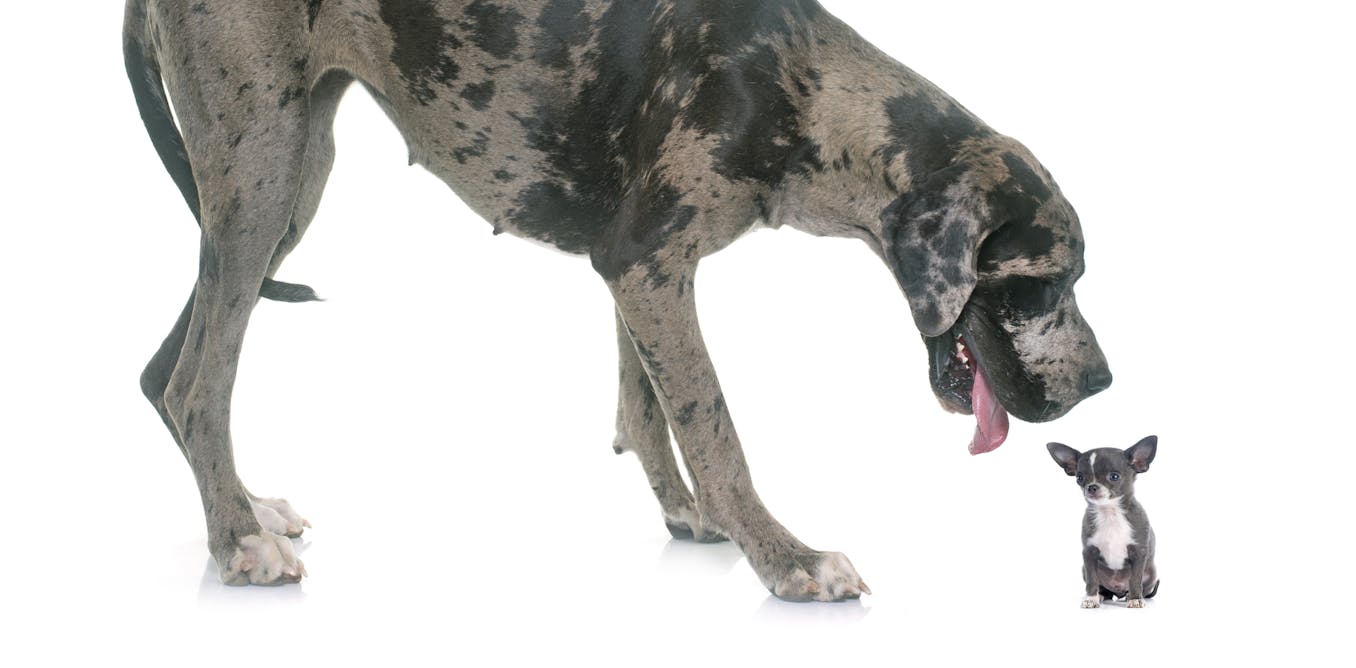
Domestic dogs are among the most diverse mammals on the planet. From the tiny chihuahua to the towering great dane, the flat-faced pug to the long-muzzled borzoi, the sheer range of canine shapes and sizes is staggering.
We often attribute this diversity to a relatively recent phenomenon: the Victorian kennel clubs that first emerged around 200 years ago. These clubs are usually credited with formalising the selective breeding that created the hundreds of modern breeds we recognise today.
But our new research, published in Science, shows that this is only the latest chapter in a much older story. Dogs were already remarkably diverse in their skull size and shape more than 10,000 years ago, long before kennel clubs and pedigrees.
This discovery challenges the idea that directed breeding alone created the physical variety we see in dogs today. Instead, our research found that early dogs had already evolved an extraordinary range of forms soon after domestication – a diversity that has been continually shaped by thousands of years of shared history with humans.
Looking for the first dogs
For decades, archaeologists and geneticists have been trying to answer a deceptively simple question: when did wolves become dogs?
The history of human interaction with wolves is a long one, stretching into the last ice age, perhaps even as far back as 30,000 years ago. But the exact timing of dog domestication is uncertain. What makes dogs particularly special is that they were the first species humans domesticated – well before any plant or livestock. Yet despite decades of research, the first dogs continue to elude us.
Part of the challenge is the similarity between wolves and dogs. Even today, some modern dog breeds closely resemble wolves. This makes tracking their domestication in the archaeological record particularly difficult. By using a technique called geometric morphometrics – a way to map and measure shape variation in three dimensions – we could track subtle changes in shape over time from 3D models of the archaeological skulls.
We analysed 643 skulls of ancient and modern dogs and wolves, spanning 50,000 years from sites mainly across the northern hemisphere to track the emergence and diversification of domestic dogs across time and space.
What we found was striking: the earliest skulls with clearly domestic skull shapes in our dataset date to around 11,000 years ago, from the Mesolithic site of Veretye in Russia.
By this point, dogs had not only diverged in terms of skull shape from wolves but had begun to diversify among themselves. These early dogs were not all alike, but instead exhibited skulls of different sizes and shapes, probably reflecting the influence of local environments, population histories and human preferences.
In fact, some early dogs exhibit skull forms not found in any modern breeds, hinting at lineages and morphologies that may have since vanished. While we don’t see some of the most extreme forms of skull shape that we see today (such as pugs or bull terriers), the variation we see by the Mesolithic is already half the total amount of variation we see in modern breeds.
C. Ameen, CC BY-SA
This echoes genetic studies that reveal deep splits among early dog populations. By the Neolithic (around 8,000–5,000 years ago), dogs had already formed regionally distinct lineages across Europe, the Near East and Asia. Some of these lineages survive in modern breeds, while others appear to have gone extinct, possibly replaced or diluted through interbreeding and human movements.
Uneven domestication
Our findings complement a growing body of genetic and archaeological evidence suggesting that the domestication of dogs was a protracted and regionally varied process. Ancient DNA research has shown that major dog lineages were already distinct by 11,000 years ago, implying that the domestication process began much earlier.
The exact timing is still debated, with some research pointing to close human-canid relationship from over 30,000 years ago. However, our study found no domesticated dogs among the 17 Late Pleistocene (126,000 to 11,700 years ago) skulls we examined, suggesting it may not reach that far back. Of course, the earliest dogs had to closely resemble wolves, and it’s possible that early dogs retained wolf-like skulls for generations, but for how long remains unknown.
There is still much we don’t know. To deepen our understanding, we need more specimens from the critical window between 25,000 and 11,000 years ago, particularly in underrepresented regions like central and south-west Asia. What this work has revealed, or perhaps reinforced, is the much older story of evolution between humans and dogs that began soon after domestication itself.
Ultimately, dogs are a mirror of human history. Their story is intertwined with ours, shaped by shared migrations, changing environments and evolving societies. As the first domesticated species – and still our most enduring companion – dogs offer a unique window into how humans have shaped the natural world and how the natural world has shaped us in return.
