



Service dog transforms Navy veteran’s life after battlefield trauma
After losing his leg to a roadside bomb in Iraq, Navy corpsman Joe Worley found healing and renewed purpose through his service dog, Benji.
Veterans who trained dogs showed an increase in telomere length, a marker of cellular aging, while a control group showed a decrease.The study highlights the potential of non-traditional, animal-assisted interventions for supporting the health of female veterans.
Perhaps you heard about the heartwarming story that went viral earlier this month when, after an 86-year-old Destin woman fell and couldn’t get up one evening while walking her son’s dog Eeyore, the “very good boy” left her side and soon led an Okaloosa County Sheriff’s Deputy straight to the moderately injured woman.
It was like a scene out of “Lassie.”
And yet more anecdotal proof that dogs truly are “man’s best friend.”
Turns out, though, that we now have more than just anecdotal stories to showcase the myriad ways dogs can positively benefit our health.
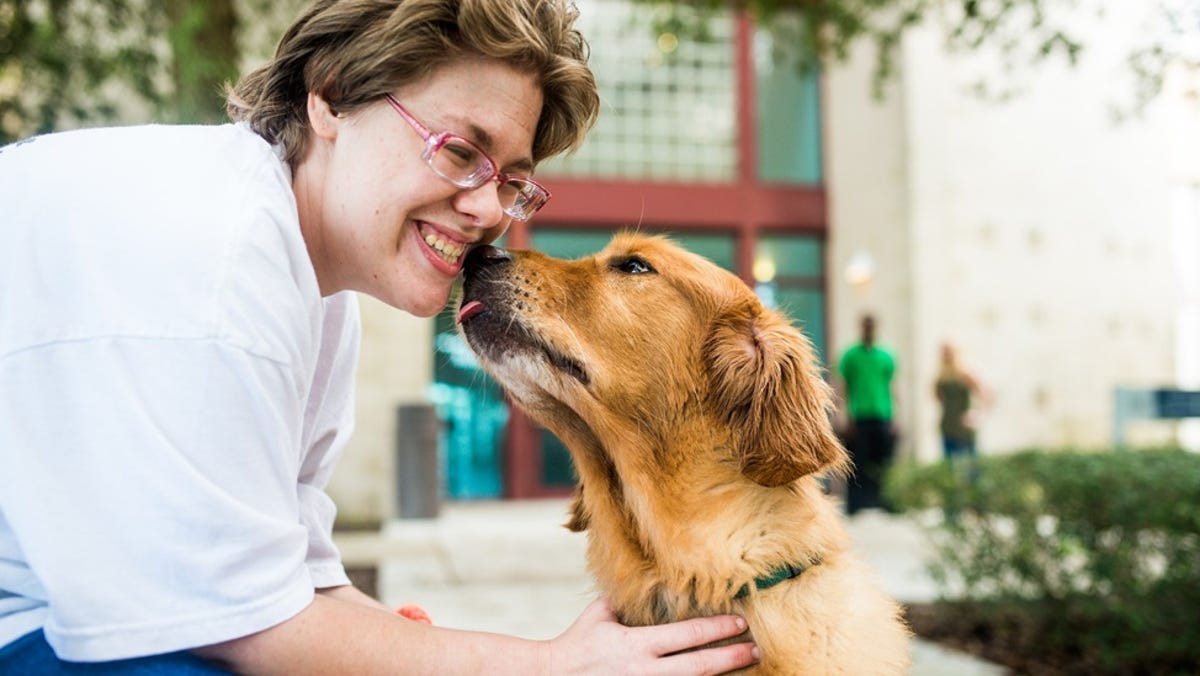
New research shows that positive interactions with pooches may help slow biological aging in women. A recently completed study focused on female veterans in the United States conducted by Florida Atlantic University researchers, in collaboration with the University of Maryland School of Nursing, the Medical College of Georgia, and Warrior Canine Connection is among the first to examine the impact of working with service dogs on this often-overlooked population.
By measuring biological indicators of stress, the researchers have uncovered a key insight: The way stress is felt emotionally doesn’t always reflect how it affects the body at a cellular level.
Unique challenges for female soldiers
Women have served in the U.S. military for generations and, regardless of recent controversial statements by Defense Secretary Pete Hegseth, their roles have expanded dramatically in recent decades and are likely to continue doing so.
Yet, despite women’s growing military presence and unique experiences, most military studies still center on men — even as women report higher rates of post-traumatic stress disorder.
That’s why researchers conducted a study focused on female veterans suffering from PTSD. But instead of receiving service dogs as is so often the case with male soldiers suffering from PTSD, these women volunteered to train them for fellow veterans in need — offering support not just to others, but potentially to themselves.
The study examined whether this purposeful, mission-driven activity could reduce both biological and psychological stress, and whether previous combat exposure influenced those effects. Until now, the emotional and therapeutic benefits of such unique relationships had been largely unexamined in female veterans.
Measuring ‘biological stress’
To measure biological stress, researchers looked at telomere length (telomeres are a marker of cellular aging) and heart rate variability (a sign of how the nervous system is behaving).
The telomere information was garnered via saliva samples while the heart rate variability was measured via wearable monitors.
The participants were divided into two groups: 1) Those who went through the service dog training program; and 2) A control group who watched dog-training videos but didn’t actually train any animals.
Researchers further assessed psychological stress using questionnaires that measured PTSD symptoms, perceived stress, and anxiety at multiple points during the study.
Interesting findings
The results, recently published in the journal Behavioral Sciences, revealed an assortment of biological benefits associated with service dog training — particularly for veterans with combat experience — while improvements in psychological symptoms were seen across all participants, regardless of whether they trained dogs or simply watched the dog-training videos.
One of the most notable findings involved telomere length.
Veterans who participated in the dog-training program showed an increase in telomere length, suggesting a slowing of cellular aging. Conversely, those in the control group exhibited a decrease in telomere length, indicating accelerated aging.
And combat experience significantly influenced these results: Veterans with combat exposure who trained service dogs experienced the greatest gains in telomere length while those with combat exposure in the control group saw the most pronounced declines.
On the psychological front, both groups — those who trained dogs and those in the control group — reported significant reductions in PTSD symptoms, anxiety and perceived stress over the eight-week period of the study. However, these mental health improvements were similar across both groups, suggesting that simply participating in the study and receiving structured attention may have offered therapeutic value. Unlike the biological findings, psychological outcomes did not appear to be affected by combat exposure.
“Female veterans face unique reintegration challenges that are often overlooked, and traditional PTSD treatments don’t always meet their needs,” said FAU researcher Cheryl Krause-Parello, one of the study’s primary authors. “Nontraditional approaches like connecting with animals can offer meaningful support. These relationships provide emotional safety and stability, which can be especially powerful for women.”
Krause-Parello noted that because “not all veterans can care for a service animal, animal-related volunteerism may offer similar healing benefits,” albeit without the expense and responsibility of being a full-time pet parent.
Researchers believe the study also suggests that the skills learned during service dog training — such as positive reinforcement and reading animal behavior — may have strengthened the participants’ bonds with their own pets at home, offering additional emotional support.
Unlike general volunteering, service-dog training provides a unique blend of emotional healing with the building of a close relationship with the animal who they’re training. Such a close, unique and goal-oriented relationship between human and animal likely provides therapeutic benefits that go far beyond that of typical volunteerism.
“This research underscores the power of service dog training as a meaningful, non-pharmacological intervention to support the health and healing of female veterans with PTSD,” said Krause-Parello. “It opens the door to more personalized approaches that nurture both the mind and body.”
Steve Dorfman is a journalist for The Palm Beach Post, part of the USA Today Network of Florida. He writes about all aspects of health, fitness and wellness. If you have news tips, please send them to sdorfman@pbpost.com. Help support our local journalism, subscribe today.
