


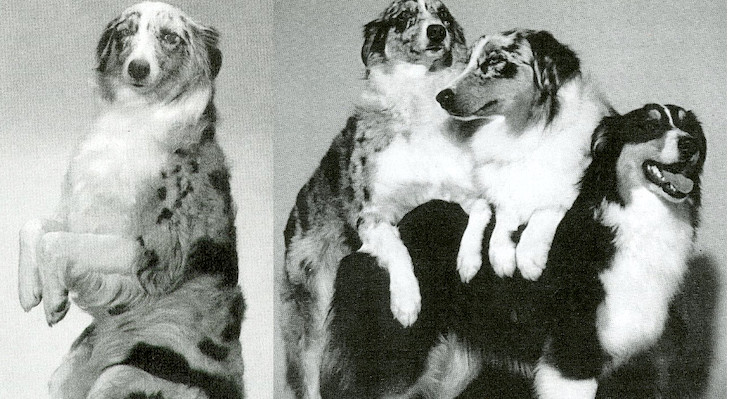
By their very nature, dog breeds are connected to specific places, reflecting both their native climates and cultures. As a result, the names of dozens of breeds incorporate their national origins, from the German Pinscher to the Swedish Vallhund to the Bernese Mountain Dog.
And then there’s the exception that proves the rule: the Australian Shepherd.
Despite its formal moniker, this medium-sized herding dog is a quintessentially American breed. They were developed in Western states like California, Colorado, Wyoming, and Idaho to tend to the large flocks of sheep grazing there. And that’s pretty much where the consensus ends.
Who was the likely ancestor who bequeathed the Australian Shepherd its medium-length coat and natural bobtail, as well as the blue eyes and merle patterning that appear in some dogs? What’s the reason for the Aussie reference in the breed name? And how much of the breed identity is owed to the Basques, a culturally distinct group of Spaniards whose tenure on the Iberian Peninsula dates back to Roman times?
Where Did the Australian Shepherd Come From?
To find the Australian Shepherd’s earliest roots, we go first to the white-washed adobe missions established by the Conquistadors, who arrived in the New World in the 1500s. Needing meat to supply their soldiers and clergy, the Spaniards imported their hardy native Churras sheep, as well as herding dogs to tend them. Some early accounts describe a wolf-like dog, much larger than the modern Australian Shepherd, yellowish or black and tan in color, and more a guardian than a herder.
For a better ancestral fit, we can look to the progenitors of the Carea Leonés, a smaller, energetic sheepdog from the León region of northwestern Spain, which herded the Churras sheep alongside the Spanish Mastiffs that guarded them. Careas have merle coats that can be of medium length, and can have blue eyes. Though there’s no evidence that the Conquistadors brought these Careas-like dogs to the Americas, their similarity to the Aussie is nonetheless intriguing.
Regardless of their provenance, as the centuries slogged on, these Spanish-derived herders procreated apace, creating a kind of generic sheepdog that populated New Mexico, California, and beyond.
In the mid-1800s, boom times jostled the breed’s sleepy evolution. The California Gold Rush created a soaring demand for sheep to feed the torrent of newly arrived miners. Plus, the Civil War’s aftermath exacerbated the need for a steady national supply of mutton and wool. The American West again found itself in need of an infusion of sheep, along with more dogs to herd them.
Little Blue Dogs — Not From Australia?
Farmers in the Midwest and East sent their flocks west, accompanied by the British-derived sheepdogs that had been tending them for generations. Many of these dogs originated from working Collies. They were often merle, as well as tricolor, and black or tan with white – typical Australian Shepherd colors and patterns.
These English Shepherds, as they were called, also occasionally produced dogs with half-tails, or no tails at all.
Most of the sheep that were brought to the West in the late 19th century were Merinos. These luxuriously coated bleaters originated in Spain, where their export was punishable by death until the 1700s, when Charles III of Spain sent some to his cousin, Prince Xavier of Saxony. After crossing the newly arrived Merinos with their Saxon sheep, the Germans soon became an epicenter of Merino breeding. One German émigrée in particular brought these improved Merinos to Australia. Here they soon numbered in the millions, before eventually traveling to a sheep-starved American West.
Newspaper accounts of these sheep’s arrival from Down Under also mentioned the Australian Shepherds that accompanied them. Much like the English Shepherds that came from the east, these “little blue dogs” weren’t a bona fide breed, but a loosely defined type. They, too, were derived mostly from British stock, as was much of Australia’s human population. No one in Australia called them Australian Shepherds – observant Americans gave them the name. While these Australian arrivals weren’t necessarily numerous, eventually every merle sheepdog earned that moniker.
A landmark 2017 Cell Reports study from 2017 underscores evidence that the Australian Shepherd we know today derives from British herding dogs, whether via the eastern United States or Australia. canine genome to see how dog breeds are related and, by extension, how they developed.
The study found that dogs can be genetically sorted into 18 clades, or groups of related dogs. The Australian Shepherd belongs to the UK Rural clade, alongside the Collie, Shetland Sheepdog, and Border Collie. Like many of the dogs in that clade, the Australian Shepherd carries the MDR1 mutation, which causes sensitivity to ivermectin, among other substances. The breed can also develop Collie eye anomaly – disease sharing that is further testament to its British roots.
A Mix of Different Cultures
Interestingly, the study also found that 10 percent of German Shepherd Dogs also carried the MDR1 gene. It posited that the Australian Shepherd either contributed to this quintessentially German breed or that the two had a common ancestor. Given the Merino sheep’s journey from Germany to Australia to the U.S., it’s conceivable that there were some German herding dogs in tow as well. It’s interesting that a merle, wall-eyed Australian breed known as the Koolie is sometimes called the German Coolie, or “German Collie,” though some authorities say it is a misnomer. Given that herding dogs are often imported alongside the sheep they tend, is it?
If that doesn’t complicate things enough, enter the Basques. From the 1870s to the 1970s, these immigrants from northern Spain found work out west as sheepherders, arriving in large numbers during the Gold Rush. Breed authorities argue over their role in the Australian Shepherd’s development. Did the Basques simply herd with the mostly British-derived dogs that were already in the West when they arrived, creating an oft-misunderstood association with the Australian Shepherd? Or did they bring their own herding dogs with them? And if they did, where were they coming from? Popular accounts say the American West’s Basque sheepherders came through Australia. But, the bulk left Spain for Argentina, Chile, and Paraguay, eventually heading north to California in the hopes of striking it rich as miners. Whether they would have brought dogs with them is an open question.
Like many Americans whose ancestors arrived in previous centuries, the Australian Shepherd is a confounding mix of many cultures, influences, and national identities. Sorting them out is likely impossible, but in the end, it doesn’t matter much. The American idiom has never been about looking in the rearview mirror.
As for the road ahead, the Australian Shepherd remains a popular breed. Reputable breeders remain cautious about popularity – not every home is appropriate for one of these clever, high-energy dogs. But the Australian Shepherd has come a long way from the lonely, wind-whipped mesas of the American West. No matter the long-ago details of how they got there, we’re certainly glad they’re here.
