



How to plan and prepare for a hike
Here are some safety tips for when hiking alone or with friends.
The 47-acre preserve has a wide, shaded 0.4-mile path that circles forested wetlands; and a 1.1-mile footpath that passes through dense foliage before returning on a flower-lined country road.Birders report spotting dozens of species, including starlings, field sparrows, tree swallows, Northern cardinals, chickadees and red-winged blackbirds.Informational signs along the trail recount the heritage of the area, from the Ice Age to Native American settlement to its colonization by European settlers.
RICHMOND – As temperatures rise and bugs swarm in the woods, hikers look for wide, flat, easy trails to get some outdoor exercise and enjoy the natural landscape.
The Richmond Heritage Trail has all that and more.
There are two loops through the 47-acre preserve: a wide, shaded 0.4-mile path that circles forested wetlands, and a 1.1-mile footpath that passes through dense foliage at times before it returns on a grassy country road lined with wildflowers.
And if your leashed dog doesn’t get enough of a workout on the trails, you can let him run free in a nearby fenced dog park.
An abundance of wildflowers and birds
I set out from the parking lot across from the entrance to the dog park and walked to the trailhead with a pine tree on the left and a towering, sky-blue water tank with a bulbous top on the right. The wide, compacted stone-dust path circled a black chain-link fence around the water tank and then passed by small grassy fields with patches of wildflowers, including red clovers, daisy fleabanes and black-eyed Susans.
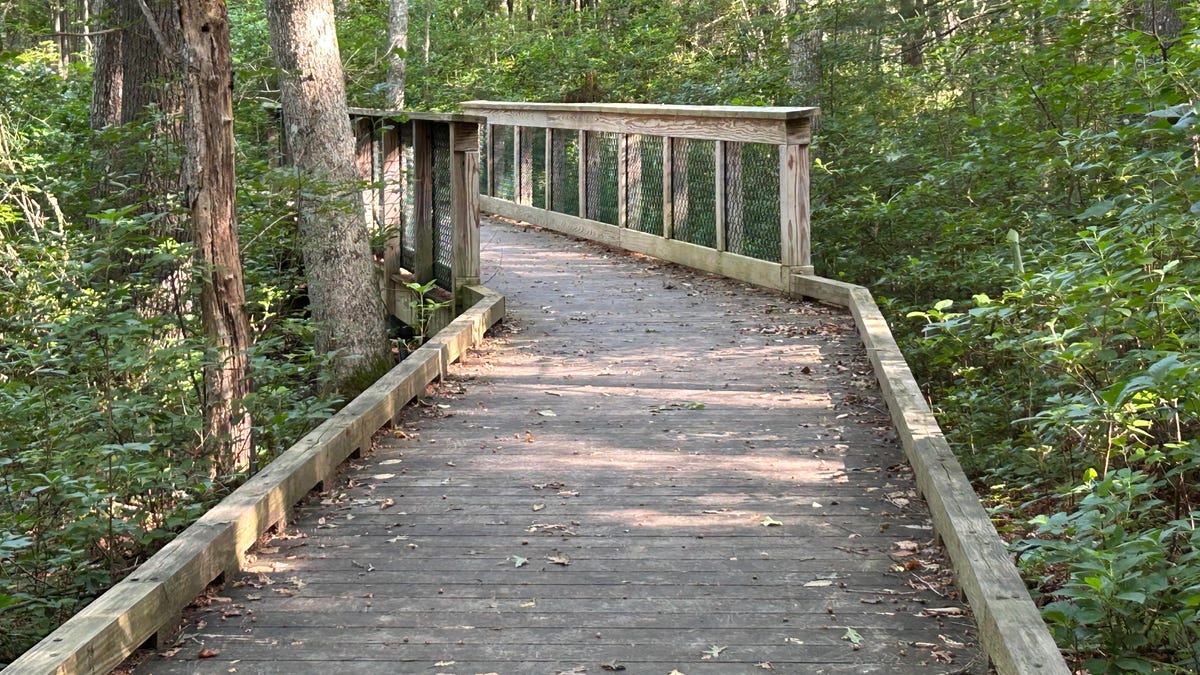
The trail then ducked into the shade under pine and oak trees and soon reached the start of a 200-foot boardwalk with edge barriers and a square wooden landing with a picnic bench. I heard tweets high in the trees but didn’t see any birds on a steamy mid-morning. At other times and seasons, birders report spotting dozens of species, including starlings, field sparrows, tree swallows, Northern cardinals, chickadees and red-winged blackbirds.
History shaped by glaciers, Native peoples and Colonists
Following the boardwalk, I stopped at the first of six informational signs along the trail that recount the history and heritage of the area. I read that the glaciers that crept across the state 20,000 years ago carved much of Richmond’s terrain. After the Ice Age, Indigenous peoples settled the area and became hunters, fishermen, collectors and farmers. Clovis point spearheads found in Richmond date the Native American inhabitants to about 10,000 years ago. The first Europeans arrived in the 1600s.
The boardwalk crossed a sturdy wooden bridge with railings over a dried-up stream bed that in wet seasons carries water west to Meadow Brook, which flows from headwaters to the north and runs south to Meadow Brook Pond and, eventually, the Pawcatuck River.
After that, the trail bends to the west and passes a junction, with the start of the blue-blazed Upland Forest Loop on the right. But I spotted a tower about 50 yards down the trail on the right and stayed on the main path. I passed another educational sign that explained how the first Europeans settled the area and signed agreements with the Narragansett Tribe. Richmond was originally part of Westerly and was set off as a separate township in 1747. The town was named for Edward Richmond, an attorney general in Rhode Island and Providence Plantations from 1677 to 1680.
Just ahead on the path is a short side spur on the right that leads to a fenced-in, gray communications tower that looked about as tall as the blue water tank. After studying the tower, I turned and retraced my steps to the blue-blazed trail, turned left and headed north on a footpath that soon narrowed through dense underbrush.
Wetlands where wild cranberries once grew
The trail passed by a junction with a trail map and a bat box tacked high on a tree. The map identified the Meadowbrook Wetlands to the northeast. To the northwest is Meadowbrook Fen, a peat-accumulation wetland fed by groundwater, where wild cranberries were once harvested.
As I followed the trail, some of which had been improved by local Scouts, several cutoffs to the left led to a country road.
I chose to stay on the main path, however, even as it became overgrown at times. I was glad I had put on bug spray and had tucked my long pants into my socks to deter ticks. The trail rose and fell in gentle inclines and descents over dry, intermittent brooks. In several places, flat stones had been set as steps to go down one bank and up the next.
The trail then made a sharp circular turn to the left, but I took a side path on the right in the direction of construction sounds. From an opening in the trees, I saw heavy equipment digging sand and stone from a gravel pit in the distance and trucks carrying the material away. Nearby, I saw pallets of mulch, topsoil and gravel in bags.
I turned, picked up the trail again and took the side spur to the country road. Headed south, I noted bird boxes and signs for the preserve. I also spotted some yellow-blazed posts almost hidden by thick weeds and invasive plants, such as mugwort, oleaster and Japanese knotweed.
There also were patches of wildflowers, such as bird’s-foot-trefoil, echinacea, wild carrot and spirea.
Tall, rod-straight, yellow-flowered mullein and purple loosestrife dotted the edge of the trail.
When I reached the cellphone tower I had seen earlier, I took a side spur on the left to the loop I had walked before. I turned right on the path that was covered with pine needles and lined with carpets of cinnamon ferns. I also noted burls on the trunks of oak trees where the branches had been cut or broken off.
A pastoral preserve, protected from development
I passed three more informational signs along the route.
One described early life in Richmond that had grown to 183 families by 1774. Another depicted a maturing town in the mid-to-late 1800s, as some farms were abandoned and the land reforested. Mills continued to produce textiles, and Kenyon’s Grist Mill became well known.
Summer Guide: Our favorite dog-friendly bars in Rhode Island, and why your pooch will love them, too
And a third explained more recent changes. Meadowburg Farm, just west of the preserve, remains, but other farmland has been developed for businesses and housing. Still, Richmond retains its rural character, with acres of open space, conservation land and reforested areas.
Continuing on, I followed the shaded path, lined in places with boulders, until I heard dogs barking, indicating I was near the end. I noted a small field and a power line on the right. On the left was a bench with a plaque labeled “In Loving Memory Stacy R. Price (1977-2017).”
Another sign in front of a stand of swamp milkweed explained that the preserve was formed in 2013 as part of the town’s approval of the nearby Richmond Commons development. The Richmond Conservation Commission planned the preserve and secured the funding from state, local and nonprofit sources to build the trail network.
I headed back to my car after walking 1.6 miles over 90 minutes.
The short loop trail in the preserve is ADA-accessible, flat and shaded. The Upland Forest Trail is narrower and a little tougher. But both offer plenty of history and fairly easy summer walks.
If you go …
Access: Off Route 138, take Country Acres Road, across from Meadowbrook Golf Course, to the trailhead.
Parking: Available in a dirt lot.
Dogs: Allowed but must be leashed.
Difficulty: Easy on wide, flat, well-marked trails, with some small hills.
GPS Coordinates: 41.-53832, -71.67129
John Kostrzewa’s book, “Walking Rhode Island: 40 Hikes for Nature and History Lovers with Pictures, GPS Coordinates and Trail Maps,” is available at local booksellers, retailers and at Amazon.com.
The Walking Rhode Island column runs every other week in the Providence Sunday Journal. Kostrzewa, a former assistant managing editor/business at The Journal, welcomes email at johnekostrzewa@gmail.com.
