


WARNING: This story contains distressing details.
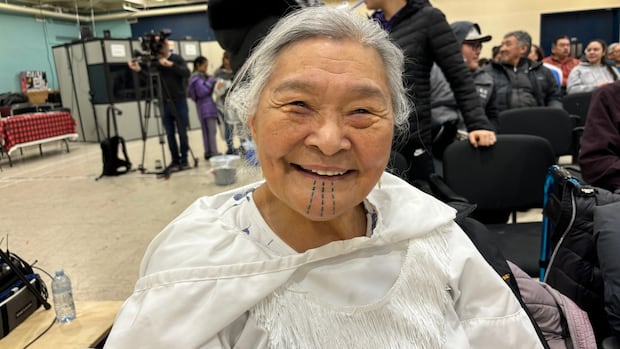
Louisa Cookie-Brown was a young girl when she saw police officers shoot her qimmiit (sled dogs) in Kuujjuarapik, Que. in 1964.
“We had dogs that were fearless, that used to go after any animals that were big, like polar bears or wolves,” she recalled.
Even as a child, she played a big role in taking care of them, whether it be feeding or making harnesses for them.
To this day, she still vividly remembers trying to shield her family’s lead dog, when a police officer pointed a gun at them and threw Cookie-Brown out of the way — twice.
“I panicked. I didn’t know what to do … I did not want him to kill our lead dog. So I went in front of the dog and [the police officer] almost shot me. He was so angry with me, he picked me up and threw me,” she said.
The police officer then killed her lead dog in front of her, she said. All of her family’s 14 dogs were slaughtered by police, and they lost their ability to go out to hunt, trap and fish.
Their dogs were among more than 1,000 qimmiit slaughtered by police and other authorities across Nunavik, the Inuit region of northern Quebec, in the 1950s and 1960s.
A 2010 report from Jean-Jacques Croteau, a retired Superior Court of Quebec judge, found Quebec provincial police officers killed more than 1,000 dogs “without any consideration for their importance to Inuit families.”
The federal government’s role in it, Croteau found, was failing to intervene or condemn the actions.
Cookie-Brown said her father turned violent after the incident.
“He became a gambler, a womanizer and started to beat up my mom at times when he was really angry. And we had absolutely nobody to talk to … to explain why we were the way we were,” she said.
“Of course, all our neighbours changed as well. They all went through the same things and at the same time the residential schools were happening, the religion was happening.”
Over time, she said she started to come to terms with what happened, guided by her grandfather’s mantra to not hold grudges and to “let God do the work”.
“Once my dad died, there were a lot of things I let go. But I used to wonder when are they ever going to apologize to our nation?”
She finally got to see that moment on Saturday, in person in Kangiqsujuaq, Que., where Gary Anandasangaree, the minister of Crown-Indigenous Relations, delivered the formal apology, plus $45 million in compensation for survivors and training initiatives to revitalize the culture of dog-sledding.
Qulliq17:09Elder remembers Nunavik dog cull – English
Louisa Cookie-Brown was just a child when she saw police officers shoot her sled dogs in Kuujjuarapik, Nunavik. She is a survivor… of the residential school system, and the dog slaughters in Nunavik in the 1950s and 60s. On Saturday she was in the community centre in Kangiqsujuaq. That’s where… after all these years… she finally heard the federal government apologize for those killings. Here she speaks with the CBC’s Samuel Wat about her experience. Please note, this story contains some distressing details.
Leading dogs to their death
Kangiqsujuaq’s deputy mayor Charlie Arngak saw the culling of his family’s dogs from the top of a warehouse of a Roman Catholic priest.
His uncles were forced to take their dogs to the bay to be killed, he said.

“Some of them had tears because they were taking their own transportation … [to be] killed by a policeman,” he said.
He still remembers the air feeling dark inside his uncle’s house the day after, with nobody wanting to talk about the horror they experienced.
He also wished the apology came earlier, so his uncle and parents could be there for it.
“Almost all of the people that lost their dogs have passed away.”
Returning to Kangirsuk and left with no way to hunt
Kangirsuk is where Johnny Peters once called home. In 1960, he was sent to Yellowknife for residential school as a 21-year-old.
As the provider for his mother and grandmother at the time, he couldn’t understand why he was being sent to school.
“I didn’t know about school. How come they were trying to send me to school? I have a dog team. I have a qajaq (hunter’s boat). Why are they trying to make me non-Inuk?,” he said in Inuktitut.

Hunting was all he knew at the time. The dogs would help them go hunting, camping, and harvesting food.
Upon returning from residential school, he realized life in Kangirsuk had changed forever. He ended up taking a job with Indian Affairs to be part of the Distant Early Warning Line near Iqaluit.
‘We are survivors’
Despite their losses, Inuit fought to keep their language and traditions alive.
Peters, who now lives in Kuujjuaq, became a central figure in the Nunavik Inuit Land Claims Agreement, as part of the Makivvik Corporation.
He held positions in wildlife research and resources, which worked well with his passion for hunting.
“Inuit never give up. Despite being left with nothing, we are survivors,” he said.
For Louisa Cookie-Brown, she set out to become a public servant in a bid to change the way the federal government views Inuit culture.
“We have gotten a lot of our culture … and things that are important to us back and we’re starting to teach children how to do a lot of things that we had learned,” she said.
As she saw those revitalization efforts progress, she finally decided to get Inuit markings on her skin — a practice that was previously taken away.
“It was to show what we have achieved. It’s like a diploma,” she said.
As It Happens6:21‘It was emotional,’ Kangiqsujuaq deputy mayor says of sled-dog slaughter apology
This weekend, Canada officially apologized for its role in the mass slaughter of sled dogs in Nunavik, the Inuit region of northern Quebec, during the 1950s and ‘60s. Charlie Arngak, deputy mayor of Kangiqsujuaq, was on hand for the apology. He told As It Happens host Nil Köksal he was just a boy when police officers came to his community to kill all the dogs.
A national Indian Residential School Crisis Line has been set up to provide support for survivors and those affected. People can access emotional and crisis referral services by calling the 24-hour national crisis line: 1-866-925-4419.
Mental health counselling and crisis support is also available 24 hours a day, seven days a week through the Hope for Wellness hotline at 1-855-242-3310 or by online chat at www.hopeforwellness.ca.
