

Close Menu
lechienrevue.com
    What's Hot

    How Many Dogs are There in the UK? 2026 Statistics & Facts – Dogster

    May 8, 2026

    Ancient Korean dog DNA decoded for 1st time, revealing distinct 2,000-year-old lineage

    May 8, 2026

    How Many Dog Breeds Are There?

    May 7, 2026

    Subscribe to Updates

    Get the latest creative news from FooBar about art, design and business.

    Facebook X (Twitter) Instagram
    Trending
    • How Many Dogs are There in the UK? 2026 Statistics & Facts – Dogster
    • Ancient Korean dog DNA decoded for 1st time, revealing distinct 2,000-year-old lineage
    • How Many Dog Breeds Are There?
    • Vet warns dog owners popular toy may cause ‘irreversible’ dental damage
    • Gorgeous, Rare Dogs Might Be Gone in 2 Decades—and One Woman Is Fighting To Save Them
    • Holly Willoughby touched by story of disabled dogs rehomed through North Wales charity
    • Why humans will give their lives to save their pets
    • Chessington World of Adventures World of PAW Patrol
    Friday, May 8
    X (Twitter) Instagram Pinterest YouTube TikTok
    lechienrevue.com
    Contact us
    • Unique breeds
    • Life style
    • Heritage
    • Stories
    • Wellness & Spa
    lechienrevue.com
    Home»Heritage»Ancient Korean dog DNA decoded for 1st time, revealing distinct 2,000-year-old lineage
    Heritage

    Ancient Korean dog DNA decoded for 1st time, revealing distinct 2,000-year-old lineage

    info@lechienrevue.comBy info@lechienrevue.comMay 8, 2026No Comments2 Mins Read
    Facebook Twitter Pinterest LinkedIn Tumblr Email
    Share
    Facebook Twitter LinkedIn Pinterest Email

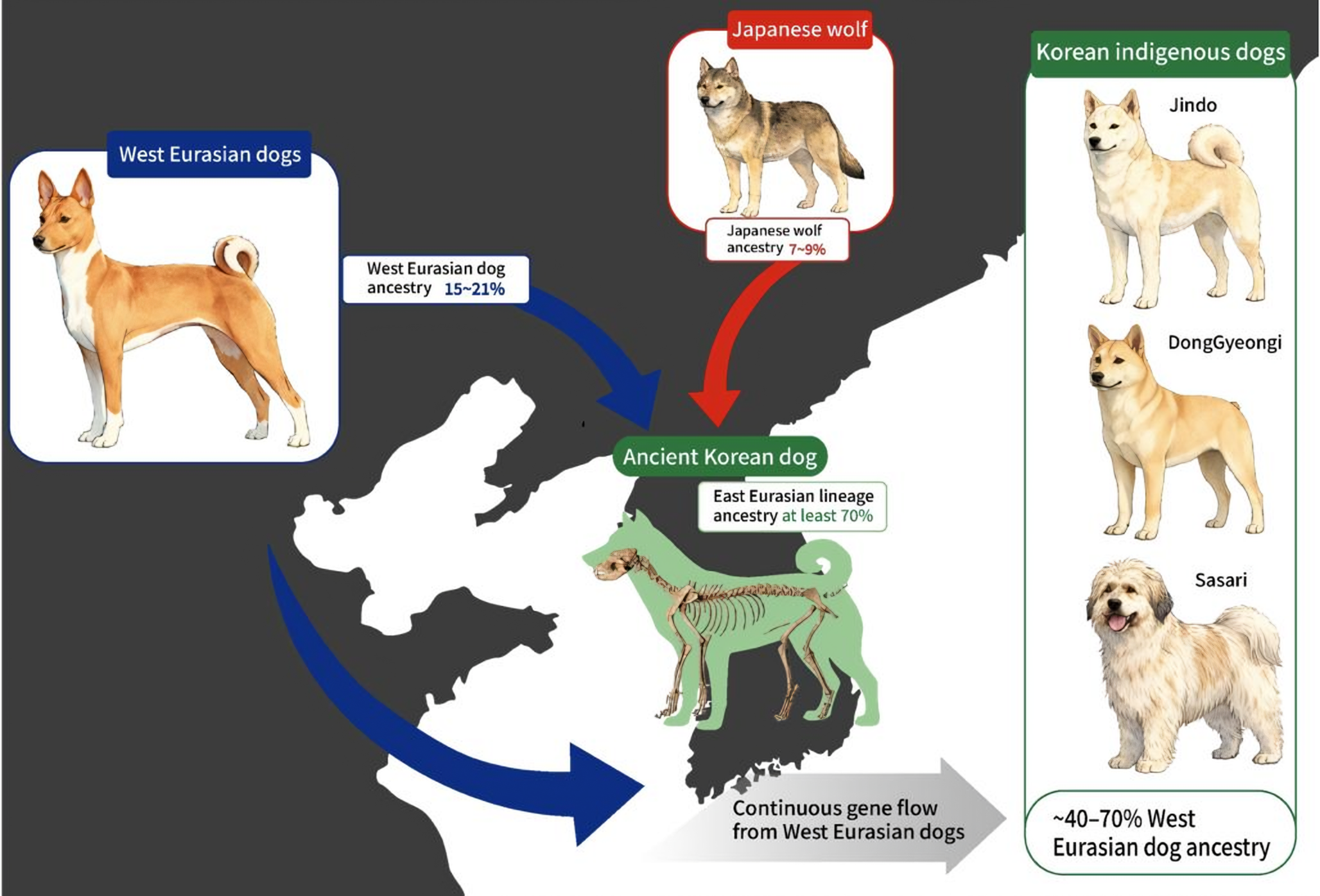
    An image for the complete genomes of ancient dogs excavated from archaeological sites on the Korean Peninsula / Courtesy of Korea Heritage Service

    A joint research team has successfully sequenced the complete genomes of ancient dogs excavated from archaeological sites on the Korean Peninsula, marking the first such analysis of ancient Korean dog DNA, the Korea Heritage Service announced Thursday.

    The study, published in the international journal PLOS ONE, was conducted by researchers from the Gaya National Research Institute of Cultural Heritage, the Conservation Science Division of the National Research Institute of Cultural Heritage (NRICH), the Seokdang Museum of Dong-A University and Japan’s Graduate University for Advanced Studies.

    The team analyzed the remains of four dogs unearthed from the Neukdo site in Sacheon and the Bonghwang-dong site in Gimhae. Using next-generation sequencing technology in a dedicated ancient DNA cleanroom at NRICH’s Conservation Science Division, researchers reconstructed the complete genomes of dogs that lived approximately 2,000 years ago.

    The analysis showed that ancient Korean dogs were genetically closest to the Australian dingo and the New Guinea Singing Dog, but formed their own distinct lineage separate from either group — indicating that East Asian dogs, long assumed to constitute a single population, in fact, comprised several distinct lineages.

    Researchers also detected Western Eurasian dog genes in the ancient specimens, with the proportion increasing in dogs from later periods, suggesting ongoing genetic exchange between Eastern and Western Eurasian dog populations over thousands of years. Modern native Korean breeds such as the Jindo and Sapsaree carry a higher proportion of Western-lineage genes than their ancient counterparts, reflecting long-term interbreeding across populations.

    The study additionally found evidence of gene flow between ancient Korean dogs and wolf populations, with the closest relationship observed with the Japanese wolf — a subspecies considered extinct since 1905.

    The Gaya National Research Institute of Cultural Heritage said it plans to obtain additional Neolithic dog genome data in an effort to trace the formation of the Korean Peninsula dog lineage to an even earlier period.

    This article was published with the assistance of generative AI and edited by The Korea Times.

    1st 2000yearold ancient decoded distinct DNA dog Korean lineage Revealing time
    Share. Facebook Twitter Pinterest LinkedIn Tumblr Email
    info@lechienrevue.com
    • Website

    Related Posts

    How Many Dog Breeds Are There?

    May 7, 2026

    Vet warns dog owners popular toy may cause ‘irreversible’ dental damage

    May 7, 2026

    Christopher Nolan calls The Odyssey ‘the ultimate dog story,’ here is why

    May 6, 2026
    Leave A Reply Cancel Reply

    Top Posts

    The Dog’s Life: A Legacy of Giants in the Mountains of Turkey

    July 21, 2025111 Views

    Black people’s complicated history with dogs

    August 3, 202522 Views

     The Rise of the British Pup Export: Why China is Falling in Love with Unique UK Dogs

    July 12, 202522 Views
    Stay In Touch
    • Facebook
    • YouTube
    • TikTok
    • WhatsApp
    • Twitter
    • Instagram

    Join Le Chien Revue

    Inspiration, stories, and canine lifestyle — straight to your inbox.

    About us

    Le Chien Revue is more than just a publication — it’s a celebration of the timeless bond between humans and their most loyal companions.
    Founded with a deep admiration for canine beauty, history, and culture, Le Chien Revue is a digital sanctuary for dog lovers who appreciate the finer details of breed heritage, the artistry of canine photography, and the lifestyle that comes with living alongside remarkable dogs.

    Our Picks

    How Many Dogs are There in the UK? 2026 Statistics & Facts – Dogster

    May 8, 2026

    Ancient Korean dog DNA decoded for 1st time, revealing distinct 2,000-year-old lineage

    May 8, 2026

    How Many Dog Breeds Are There?

    May 7, 2026

    Join Le Chien Revue

    Inspiration, stories, and canine lifestyle — straight to your inbox.

    lechienrevue.com
    X (Twitter) Instagram Pinterest YouTube TikTok
    • About Us
    • CONTACT US
    • Privacy Policy
    • Terms & Conditions
    • Disclaimer
    © 2026 Le Chien Revue. All Rights Reserved.

    Type above and press Enter to search. Press Esc to cancel.