


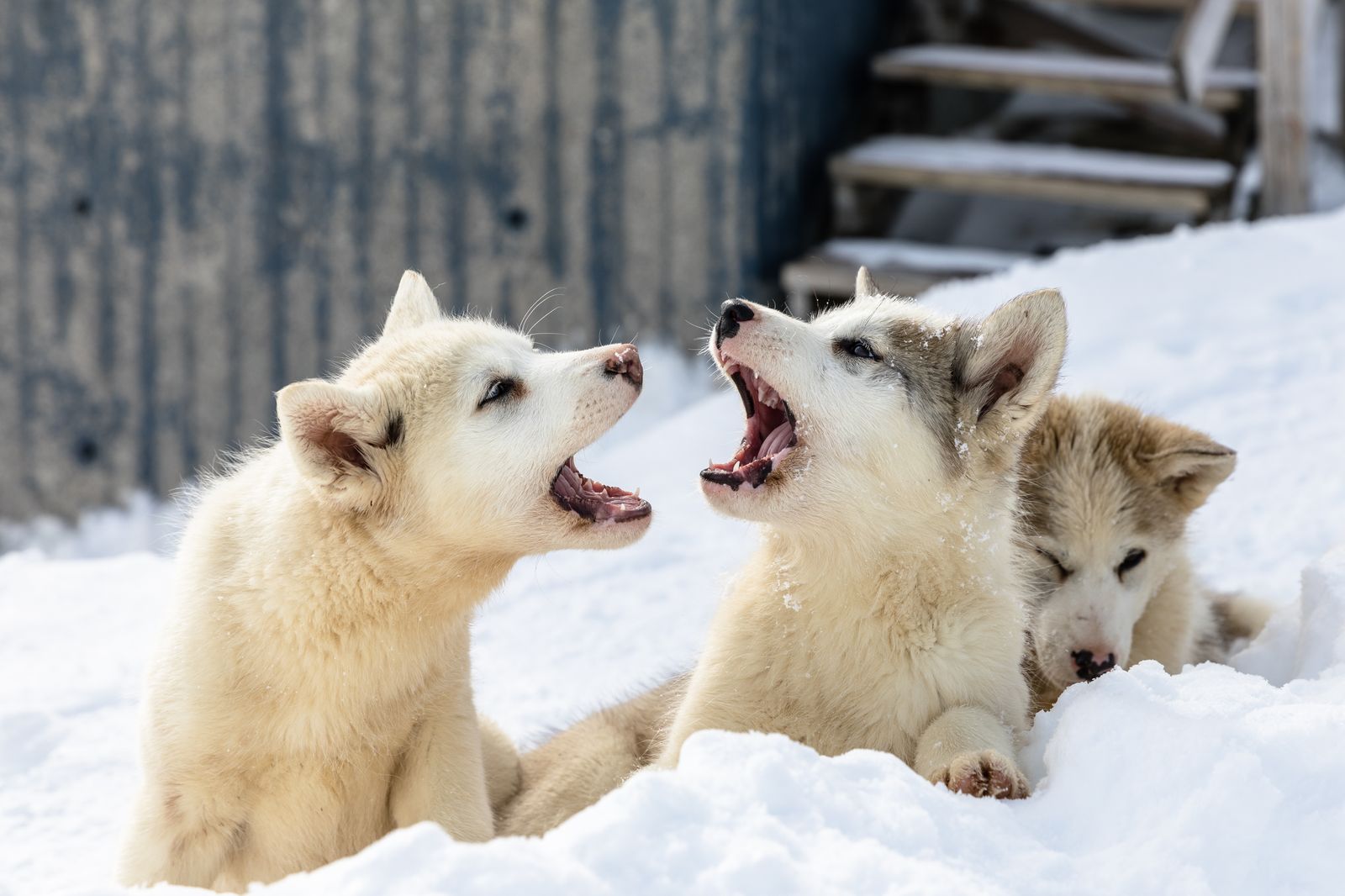
Researchers analyzed ancient and modern genetic samples of the Greenlandic Qimmit breed to shed light on the long relationship between the Inuit and their dogs in the Arctic
Greenlandic sled dogs, also known as Qimmit, play while resting.
Markus Trienke via Wikimedia Commons under CC-BY-SA-2.0
Man’s best friend has been our faithful companion for thousands of years. Recently, however, researchers have realized that this inseparability means the DNA of Greenland’s sled dogs, called Qimmit, could hold new information about our shared journey.
“The Inuit and the dogs, like their histories, are just so intrinsically tied together,” Tatiana Feuerborn, an paleogeneticist at the National Human Genome Research Institute, tells Nature’s Katie Kavanagh.
In a new study, published last week in the journal Science, Feuerborn and her colleagues analyzed both modern and ancient DNA of Arctic sled dogs and changed the story of human migration through the region over the past several thousand years. While the genomic results verify several ideas scientists already had, they also suggest the ancestors of the Inuit arrived in Greenland earlier than previously thought—potentially even before the arrival of the Vikings.
“There’s been this debate back and forth… so now this might push a little more towards the earlier arrival of the Inuit into the North,” rather than the Vikings, Feuerborn tells Popular Science’s Lauren Leffer.
Did you know? Greenland’s special sled dogs
The sled dogs of Greenland—known as Qimmeq (singular) or Qimmit (plural)—are unique among Arctic dog breeds, because they’ve consistently worked in the same region, alongside the same group of people, for almost 1,000 years.
The Qimmeq might be the oldest dog breed on Earth.
To reach these conclusions, the team extracted DNA from 92 Qimmit spanning the last 800 years, with 63 of those being modern dogs. For the older specimens, they extracted genetic material from bones, skin and fur preserved in clothing in museum collections. The scientists then sequenced the canines’ genomes and compared them with roughly 1,900 previously published dog genomes, revealing some surprising results.
First, Greenland’s Qimmit are genetically distinct from wild wolves, despite intentional efforts to interbreed the species for the health of the sled dog population. The team was “shocked” by that result, Feuerborn says to Popular Science. The Qimmit were also distinct from European dogs, even post-European contact with the Inuit.
Some findings reinforced ideas researchers previously had about the Inuit. For instance, the Qimmit are geographically separated into four populations across Greenland, mirroring the different Inuit cultures on the island. This bolsters the idea that these human populations didn’t really mix.
Since the four sled dog populations shared a common ancestor 1,000 years ago, as the DNA analysis revealed, the Inuit likely migrated into Greenland around that time, which is a couple centuries earlier than researchers had thought, reports Science News’ Jake Buehler.
Qimmit pull Inuit travelers in Greenland in the 1890s. This photo first appeared in Robert Peary’s Northward Over the Great Ice in 1898. Public domain via Wikimedia Commons/https://tf-cmsv2-smithsonianmag-media.s3.amazonaws.com/filer_public/7b/b4/7bb4e911-cf54-4926-ad27-78a615c6fa83/sled_dogs_in_greenland_1890s.jpg)
The study’s findings about human migration are possible because of the close relationship between these dogs and their human keepers over the centuries. For almost 10,000 years, people in the Arctic have kept dogs for hunting and sledding, breeding them for desirable traits. The Inuit people of Greenland “know what a good dog looks like,” Anders Johannes Hansen, a geneticist at the University of Copenhagen and senior author of the study, tells Science News. “They’ve selected really hard on what they believe a good sled dog should look like.”
Because of this breeding over such long periods of time, the dogs’ genomes hold evidence of human activities. By looking for common ancestors and certain genetic traits, researchers have “used the dogs as a lens to see the human culture through,” Hansen tells Nature.
This study and similar pieces of research show the value of looking beyond our own species toward those that surround us, even when trying to learn about ourselves. Audrey Lin, an evolutionary biologist at the American Museum of Natural History who was not involved in the study, tells Science News that “if we have any curiosity about ourselves, about us as humans, we have to understand dogs.”
