


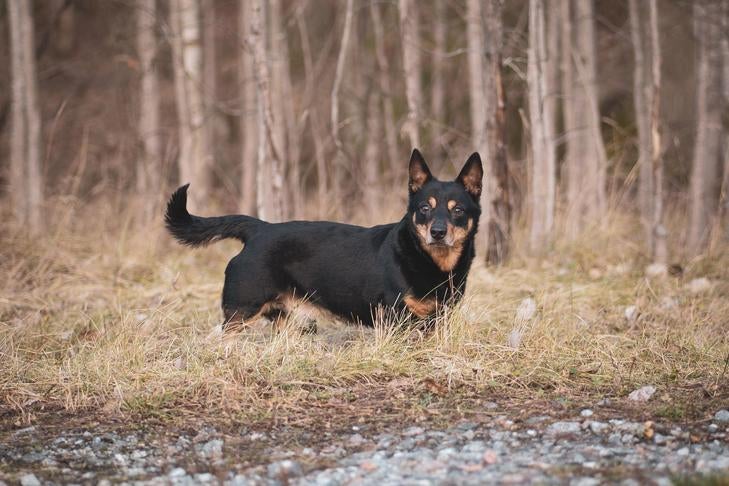
The instincts to lead livestock on the right path and chase down rats run strong in the Lancashire Heeler. After all, this breed’s history is incorporated within its name. Properly known as Heelers, the Lancashire is the only AKC breed with “Heeler” in its official name.
Vikings brought these short-legged dogs to the British Isles as an all-purpose farm dog. The Kennel Club in the United Kingdom recognized this hard-working breed in 1981. In 2007, the United States Lancashire Heeler Club was formed, and the breed became fully recognized to compete in January 2024.
How did the Lancashire Heeler acquire the label? Some dogs, like the Doberman Pinscher, are named after the person who bred it — Louis Dobermann, in that case. Others receive their names from the job they perform. After observing a small dog pursuing vermin, Teddy Roosevelt coined it the Rat Terrier. The Poodle’s association with water puddles helped identify them. Other dogs, such as the Dogue de Bordeaux, purportedly received their handle by location — Julius Caesar’s armies introduced Dogues to France.
Dual Purpose Dogs
The Lancashire Heeler obtained its double designation from where it originated and its purpose. A popular dog in the Ormskirk area of West Lancashire, England, this friendly, black and tan or liver and tan canine’s primary job was as a cattle herder and a ratter. Bred in that area for generations, it eventually moved into homes as a family companion.
“They lived on farms, worked in the fields, and were used to drive stock to market in northern Wales to the Lancashire market, but the breed isn’t well-known, if at all, here, including at a dog show,” says Jeff Kestner, Club Chair of Judges’ Education Committee of AKC’s parent club, the United States Lancashire Heeler Club.
Surprisingly, AKC-licensed conformation judges Kestner and Jeff Bazell were showing their first Lancashire Heeler “Willy” (Welshmore Willynilly) at a dog show when professional handler Andrew Peter Peel, born in Wales, recognized the breed.
“Peel remembers his grandparents keeping a pair of Heelers on their farm, and the village they lived in had another pair,” Kestner of Bremen, Ohio, says. “Peel recalls that when the dogs drove cattle and sheep through the town, the village duo of Heelers kept the flocks on the main road and diverted them from drifting off to the side alleys.”
According to Kestner, after the dogs delivered the cattle securely to the market, the Heelers followed the people into the local pub and hung out. When the pub closed, the Heelers wandered off or followed a farmer home who would let them in and feed them before the dogs fell asleep by the fire. The next night, these dogs would lie in someone else’s home.
“Generally, they were companions for the whole community,” Kestner says.
How the Heeler Handles Its Responsibilities
While other herding breeds use eye contact, circling, barking, or running along an imaginary fence line to intimidate wayward animals in a herd to move in the desired direction, Heelers drive stock by nipping at the animals’ heels.
The Lancashire Heelers’ short legs and flat skull guaranteed their longevity as they evolved. These two attributes protected the dogs when driving the five-foot-tall Scottish cattle. When the Heeler nipped at the animal’s heels to move it into position, the cow kicked its hoof, but the dog’s anatomy escaped the attack. “The Heeler is purposely built low to the ground to allow its chest and head to drop just enough to allow the hoof to pass over its head,” Kester says. If a dog had a rounded skull and was too tall to duck, it would get kicked. Lancashire Heelers were able to continue to thrive because they would wield off these kicks to continue to successfully heard cattle.
Back to the Beginning
The Lancashire Heeler’s precise origins are unknown, and records depend on the source. Still, short-legged dogs are depicted in Futhark and Runic symbolization and artwork from the ninth through the 12th century. Some theories say the Lancashire Heeler’s ancestry comes from Manchester Terriers and the Cardigan Welsh Corgi.
The Kennel Club maintains that the Lancashire Heelers descended from short-legged dogs that the Vikings brought to the British Isles in their longships. “It makes sense that the Vikings would bring short-legged dogs in their long boats because long-legged dogs would have fallen over the sides,” Kester says.
According to Kester, these black and tan smooth, short-coated dogs became the Lancashire Heeler, and the short-legged rough coat became the Swedish Vallhund. Genetically, the colors and coats of the two breeds are closely related. “We believe the Heelers are the progenitors of all the achondroplastic (short-limbed) breeds like the Dachshunds,” he says.
Edge of Extinction
Today, most farmers use trucks and trailers to transport their stock, rather than depending on Lancashire Heelers to drive cattle and sheep to market. “As a result, breeders aren’t producing many of these dogs anywhere in the world, and their numbers are low,” Kestner says, “Like many progenitor breeds once used to perform a job they no longer do, it’s forgotten.”
Due to the small gene pool, the United Kingdom’s The Kennel Club added the breed to its Vulnerable Native Breeds list in 2003.
Along with other United States Lancashire Heeler Club members, Kestner and Bazell anticipate that more people will discover this affectionate, versatile, and adaptable breed.
“Jeff and I appreciate the breed’s intelligence, the way they bond so well with their families, and how their expression and eyes draw you in like magnets,” Kestner says.
