


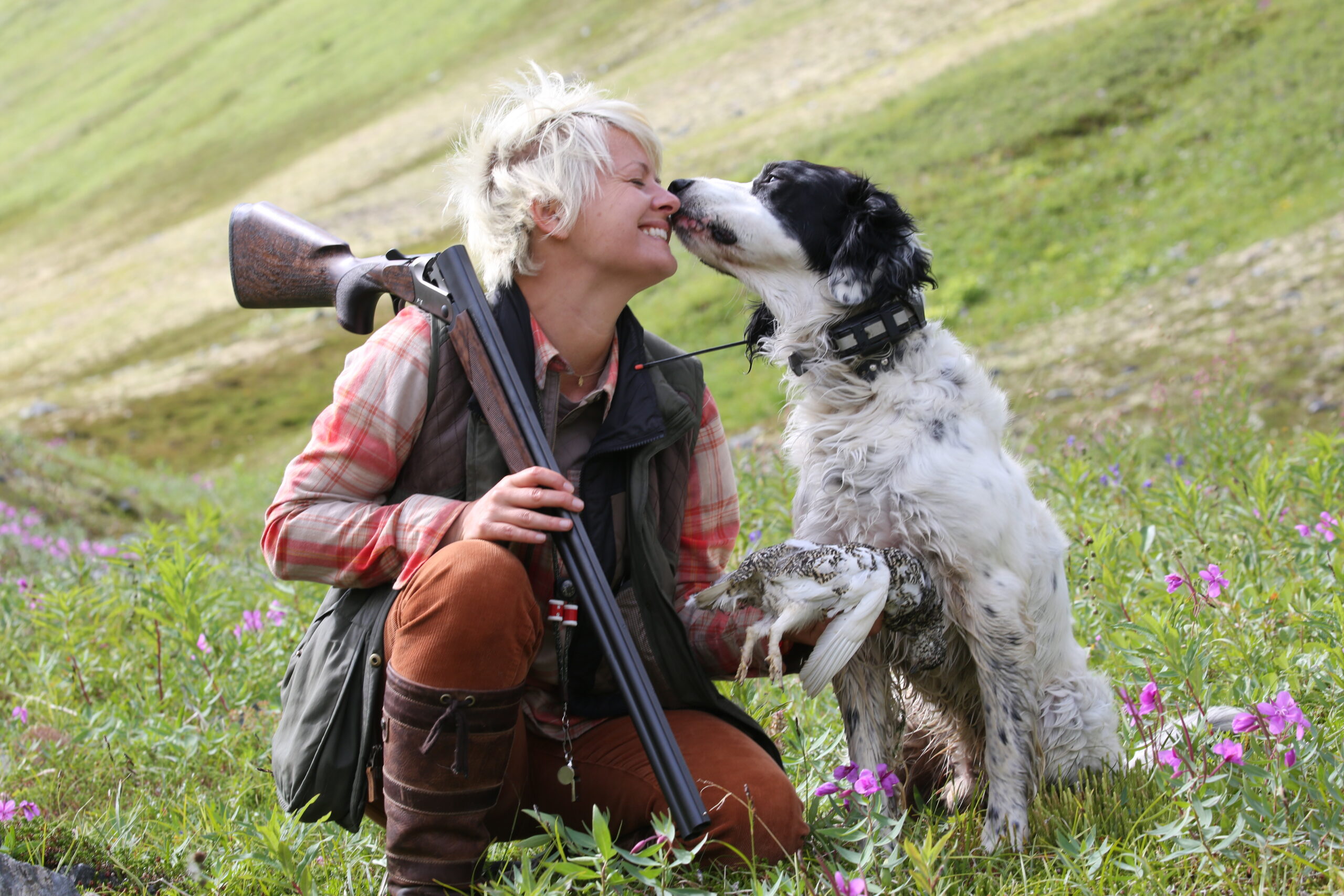
The following appears in the February issue of Alaska Sporting Journal:
Note: Across Alaska, women are shaping the outdoors through their work, their families and the time they spend on the land. They’re hunters, anglers, guides, artists, foragers, conservationists, and lifelong learners. Each profile in this series introduces readers to one woman whose relationship with Alaska’s wild places has influenced the way she works, lives and contributes to her community. These stories highlight a shared respect for the land and the many ways women connect with it. We begin the series with writer and hunter Christine Cunningham – a frequent Alaska Sporting Journal contributor over the years – whose life has been shaped by the dogs, landscapes and experiences that drew her into the field nearly two decades ago.
BY TIFFANY HERRINGTON
Some hunters arrive in the outdoors through family tradition, mentorship or childhood memories. Christine Cunningham arrived in her late 20s with borrowed gear, a head full of questions and a willingness to crawl through wet grass toward a pair of wigeon on the Kasilof River Flats, shotgun in hand. What she experienced that day changed the course of her life.
In the years since that moment in time, Christine has become a highly respected Alaskan writer, a passionate bird hunter and someone whose days have been shaped by the dogs she’s trained, traveled with and loved. Her reflections on hunting, community, wild places and the role of women in the outdoors are honest and deeply felt. Her connection to the land isn’t sentimental; it’s lived, earned and rooted in a desire to give more than she takes.
The following conversation preserves Christine’s voice exactly as she shared it: real, reflective, funny and grounded in truth. Her perspective is a reminder of why these stories matter and why the people who live them deserve to be heard.

Tiffany Herrington How did your connection to the outdoors begin? Was there a particular moment or experience early in life that shaped your love for hunting, dogs and Alaskan landscapes?
Christine Cunningham My first memory is of being outside, and my best memories are in the outdoors. Although I was born and raised in Alaska, no one in my family hunted. I was 27 when I invited myself along on a duck hunt with my hunting partner Steve [Meyer, also a former Alaska Sporting Journal correspondent]. My reasons for going were somewhere between wanting to learn something new and feeling an intellectual responsibility for knowing something about where meat came from. I remember it was raining that morning, and I asked if we should still go in the rain. I had no clue.
The particular moment that changed me was crawling through the grass on the Kasilof River Flats. I had seen shrews darting into the grass, spider webs and a rotting salmon. When Steve said we had to crawl up to a pair of wigeon, I really thought he had to be kidding. I tucked my gloves into my sleeves and got down on my stomach, using my shotgun to flatten the grass as I crawled, and something took over in me. I loved it. I felt alive. I felt like I was participating in life in a way that was direct and real. It’s like I never knew myself before that. I never knew I was capable.
When I got to the pond and the wigeon flew, I shot just once – a sure miss and nothing like shooting at the range, where Steve had showed me how to shoot clays. I watched the two ducks fly away, and Steve picked up the spent shell, held it up to my nose and said, “This is what fall smells like to me.” I fell in love with it. The dogs and everything else that shaped my life came after that.
TH What originally brought you into hunting, and how has your relationship to the outdoors evolved over the years?
CC After that initial duck hunt, I went duck hunting as much as I could – before and after work and on weekends. I read everything I could about waterfowl – the old duck hunter stories, the conservation story, the bird identification and biology stuff. I joined a lot of organizations – Delta Waterfowl, Ducks Unlimited, Pheasants Forever. I have a big bag of stickers and patches. I signed up to teach hunter education with Steve through the state program. I got on forums back before everyone migrated to social media. Females were underrepresented in the literature and not online as much.
It seemed like my interest was a novelty, even though nothing about me was exceptional. I was featured in my local newspaper under the headline “Duck-o-holic.” This was around 2006. The conversation in the outdoor arena then was about how women were the only hunting demographic that was growing and what could we bring? Would we ruin it for the boys? Were we more likely to normalize the hunting life in our families? Would we create a new market for gear? Most of what I felt was a rally of support.
What has changed most for me is along that arc – from initial curiosity, to wild obsession, to group affiliation and self-exploration, to time with the Labs on the Flats, to time with the setters in the mountains, to personal moments of reflection. The relationship to the outdoors is like any relationship arc. You might start out wildly and maybe even blindly in love, and if it’s true love, it gets deeper, more emotional and aware, and it begins to include sacrifice. You start trying to give more than you take. And there are moments that shape you. I don’t have kids or a traditional family. I have a hunting partner and dogs that sleep in the bed.
TH For readers who may be new to your work, how would you describe the role the outdoors plays in your life today?
CC Participating in nature as a hunter rather than an observer changed me. For years I looked forward to going to the duck blind and being immersed in the totality of that environment. I became aware of my small part in an integral whole. That’s still there even though I can’t feel the awe of it being brand new. I am haunted by a lot of memories – dogs that have passed, places that have changed. I love the outdoors, and I go to certain places like some people go to church. People talk about hunting being “sport,” but for me, it’s not like that. I have a spiritual need to connect to nature.
TH You’ve spent a great deal of time hunting in Alaska. What is it about the Alaskan landscape, wildlife or hunting culture that continues to draw you in?
CC It’s my home. I love Alaska – the mountains, the flats. I loved being on the north side of the Brooks Range. We went there during the solstice one year – not even to hunt; just to get to know it better. That feeling of being remote is like nothing else. I don’t want to be in traffic. I don’t want to be a part of the human problems. But it’s not escape; it’s going deeper in. If you have just a bit of that desire to be wild and free, it draws you in. People will talk about that moment when the bush plane flies away, like there is a bit of fear or something. I have never felt that. I love when the plane flies away.


TH Are there certain hunts or locations in Alaska that hold special significance for you?
CC The mountains, the tidal flats – they’re just bigger than you. They’re beautiful and terrible. Not everyone loves to be exhausted or bug-bitten or wet and cold. Some people need it. For me, the price of admission is not too much; it’s worth everything it takes, even if it takes my life, and it absolutely can. Why? I’m not sure there’s a why. We live in a world of stuff and things. It’s not very fulfilling for me. You can’t take it with you.
TH How have you seen hunting culture in Alaska change or stay the same over the years you’ve been involved?
CC A lot has changed and stayed the same. There’s more specialized gear and technology.
TH You’re well-known for your writing about retrievers and hunting dogs. What first drew you to working with dogs, and what do you love most about the human-dog partnership in the field?
CC It was early in my hunting life that I went to North Dakota to hunt pheasant with Steve, his dad and his dad’s best friend Eddie. Eddie had an English cocker named Windsor, and I loved watching him work the pheasant fields. I’d never seen a hunting dog at work before. At the tailgate with Eddie, we talked about Windsor – what a good boy he was – and Eddie said that he was getting older and he only went for the dog anymore. I didn’t understand that. It seemed backwards because I was thinking about getting a dog to help me retrieve ducks.
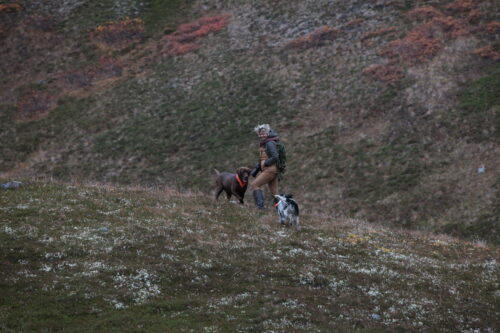
It’s probably taken me 20 years to really understand what he meant. Yeah, you go for the dog sometimes. Especially in upland hunting, because you’re watching the dog (as opposed to the sky or the next bend, as Leopold says). When you watch the dogs and see what they’re capable of, it’s inspiring. I’ll never run that far or fast. I’ve said before that they are like a medium between the wild and domestic, and that may sound overly romantic, but it’s there for me. Watching a setter in the mountains is like what it might be for some people to watch an opera or a ballet – it’s so beautiful, so rich in life, like a work of art that is alive. The dogs want to go there and do what they were born to do more than anything, and I want to take them there. I’m a total dog mom. Their pictures are all over the house.
TH Do you have a memorable story about a particular dog or hunt that stands out as especially meaningful?
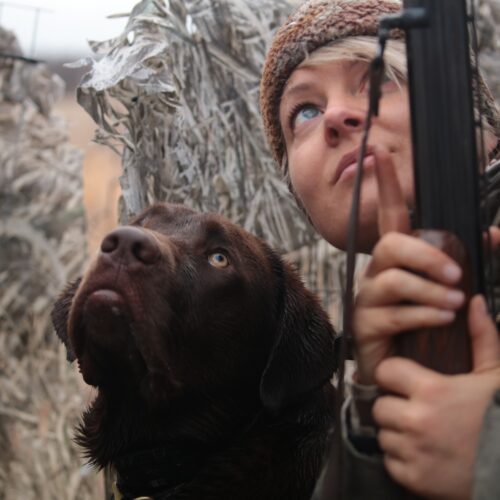
CC One of my favorite stories of Cheyenne (a small chocolate Lab) is from a day Steve and I were duck hunting. Midday, we left the blind to walk the flats in search of ducks. I saw some wigeon about 400 yards away on a pond and asked Steve to hold Cheyenne back so I could crawl up on the ducks. As I was crawling, I could hear that she broke loose – she’d slipped her collar. I figured she was going to charge the pond and flush the ducks out of range. But instead of running past me, she tucked in next to me, and we crawled to the ducks together. That’s something people who train dogs to follow commands might not realize about a good hunting dog, that there’s something better than a dog doing what you tell it to do. A hunting dog brings their gifts, often superior to ours, to the hunt, pays attention to what is going on, and becomes a true hunting partner.
TH What inspired you to begin writing about hunting and life in the outdoors? Was there a turning point when you realized storytelling would be part of your life?
CC Shortly after my first time duck hunting, I was telling a girlfriend about it. I told her about the rain, the ill-fitting borrowed gear, the smell of rotting salmon. She would react to every detail with a head shake and wince. She’d say, “Oh, honey,” or “Oh, no.” I told her about cutting my finger and not having a Band-Aid. (Steve would say, “If a Band-Aid would fix it, it’s not that bad.”)
Later that night, I was thinking about how funny it was that she gave me so much sympathy, and in the field I was getting no sympathy. I got up and wrote a humor piece about duck hunting titled “No Sympathy.” I felt really confident about it and emailed it to a magazine that same night. In the morning, I felt like I should have edited it, I shouldn’t have been so confident. I had a Jerry Maguire moment – “What did I just do?” I wondered. For months I heard nothing – back then print was slower. Then the editor responded and said the story had merit. It was eventually published in Alaska magazine, and it really gave me confidence in the idea that I could write for publication. I kept it up.
TH When you sit down to write about a hunt, a dog or an experience in Alaska, what are you hoping readers take away from your stories?
CC I love to read a good story. For me, that means a story that sounds like it’s being shared with a friend. I want to know what someone saw, what they felt, what is worth remembering. I quote a lot of what I read. So when I write, it’s like I’m talking to a friend, sharing what matters. Readers have written to me and become friends. That’s all storytelling is; as Jim Harrison said, “Death steals everything except our stories.”

TH What has your experience been like as a woman in Alaska’s hunting community? Have you noticed any shifts in how women are represented or included in the outdoors?
CC I love the way that women include and support each other in the outdoors. That has always been important to me and has been a constant. We’re not all lucky enough to have a trusted person introduce us to hunting, and many women are interested in hunting as adults, maybe for the initial reasons I was – healthy food, an interest in learning self-sufficiency, being capable of caring for ourselves and our families in a first-hand way.
There are a lot of great communities of women supporting each other in Alaska. How women are represented has shifted since I started hunting, but representation is never the real thing. We have a lot of the real thing in Alaska. A lot of phenomenal role models who don’t worry about how they are described.
TH What advice would you give to women who want to explore hunting, fieldwork or outdoor writing but may feel intimidated or unsure of where to start?
CC That’s tough for me to answer because I had Steve to help me get started. I have experience with the Becoming an Outdoors Woman program, and it offers a great environment to start, but you might really need someone to take you under (his or her) wing and be there to answer questions. That’s where finding a community can really make a difference. It might look different depending on where you live, but if there’s a local chapter of a hunting or conservation organization or a gun club, that can be a place to start making connections.
TH What do you feel is most misunderstood about hunting or outdoor life in Alaska, especially among people who haven’t experienced it firsthand?
CC I think Sidney Huntington describes it best in Shadows on the Koyukuk. It’s a great read for anyone interested in hunting in Alaska. I don’t have my copy close enough to grab, but he talks about the scarcity of game here. The land is big, but it’s not like there’s a lot of game – not like deer in the Lower 48. It’s poor country in many places. If you’re going to hunt or spend time outdoors in Alaska, it’s going to help to know as much as you can about what to expect. That can be big changes in weather and the experience of terrain that cannot be captured in a photo or video.
TH Looking ahead, what are you excited about – either in your writing, your time outdoors or future hunts?
CC These days, I look forward to adventures closer to home with the dogs. We have five English setters that are all over the age of 11, a 5-year-old Lab named Rigby, who was diagnosed with a T-cell lymphoma, and an adopted springer-setter that needs to run 10 miles a day and splash in water. Every day I get to be outside with them is a gift, even if it’s our daily walk or an hour on the flats, preferably at sunrise or for last light. ASJ
Editor’s note: Follow Christine Cunningham on Facebook (@christine.cunningham.98) and Instagram (@cunningham_christine). Tiffany Herrington is a Seattle-based writer.
