


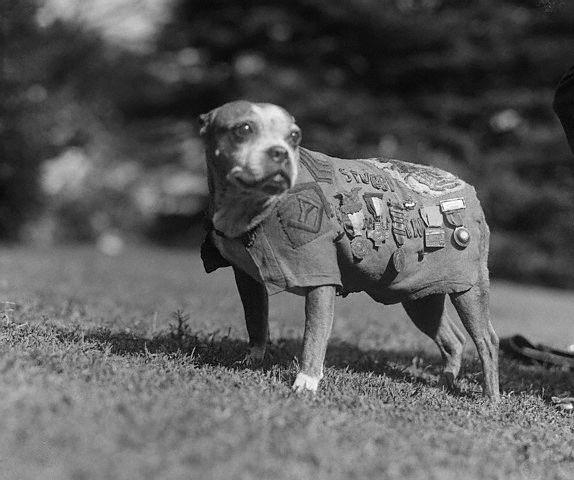

Stubby visited the White House to call on President Coolidge in November 1924.
Image Credit: Wikimedia Commons / CC
Throughout history, dogs have left their paw prints on events that have changed the world around us. From heroic actions on the battlefields to inspiring scientific inventions and even saving entire civilisations, here are 6 dogs that changed the course of history.
1. Alexander the Great – Peritas

Mosaic of a stag hunt from Pella, which likely depicts Alexander the Great and Peritas.
Image Credit: Wikimedia Commons / CC / inharecherche
One of the most famous military commanders in history was Alexander III of Macedon, born in 356 BC. The great commander had many war dogs that fought alongside him during his numerous military adventures. His particular favourite was named Peritas, and was a powerful ancient dog, similar to an Afghan Hound or an early type of Mastiff, that Alexander trained to be a fierce fighter.
Alexander’s uncle is said to have gifted Peritas to him as the dog had previously fought off both a lion and an elephant. The dog then became a loyal companion to Alexander on the battlefield. It was here that Peritas saved Alexander’s life during a battle in India where the dog defended his wounded master from the attacking Mallians, holding them off long enough for Alexander’s soldiers to arrive and save him. Peritas, who was mortally wounded, is said to have laid his head on Alexander’s lap and died.
Thanks to his dog, Alexander went on to build the empire that became the base of Western civilisation. Alexander named the Indian city of Peritas in the dog’s honour, as well as giving his favourite pet a celebrity style funeral, and ordered that the city residents should honour the dog each year by throwing a huge festival to celebrate the heroic actions of Peritas.
2. Robert the Bruce – Donnchadh
The faithful bloodhound of Robert the ‘Braveheart’ Bruce, not only changed Scottish history, but may have altered the course of history in the United States too.
Donnchadh, which is an old Gaelic version of the name Duncan, was one of Robert the Bruce’s prized bloodhounds, a breed popular with Scottish nobility.
In 1306, when Edward I of England sought to stop Robert the Bruce’s plan to rule Scotland, his soldiers plotted to use Robert’s dog Donnchadh to seek out Robert who had gone into hiding in a secret location. The loyal dog did indeed catch his master’s scent and led the soldiers right to Robert. However, as soon as the soldiers started to capture Robert the Bruce, the dog quickly turned back on them, fighting them off and allowing Robert to survive and become the King of Scotland.
Some generations later, the actions of Robert the Bruce’s direct descendant, King George III, known as ‘The Mad King’, contributed to the conflict with American colonies in the Americas that led to U.S. independence.
3. Pavlov’s Dogs

Taxidermied dog in Pavlov’s experimental Museum of Hygiene in St. Petersburg
Image Credit: Shutterstock
Russian scientist Ivan Pavlov, who won the Nobel Prize in 1904, is credited with the discovery of one of the most important concepts in psychology known as Classical Conditioning. But it was during a series of experiments on the digestive response in dogs that he accidentally uncovered one of the most important discoveries in psychology.
In the 1890s Pavlov was conducting a series of experiments using several dogs, testing their salivary response when presented with food. But Pavlov began to notice that his canine subjects would begin to salivate whenever an assistant entered the room. He discovered that that the dogs were beginning to salivate in response to a stimulus that was unrelated to the food. He did further experiments with noise’s such as a bell ringing just as food was served and noted that the noise itself was enough to stimulate the dogs saliva, even without the food being served.
The discovery of classical conditioning remains one of the most important in psychology’s history and has helped shape our understanding of human behaviour.
4. Sergeant Stubby

Stubby visited the White House to call on President Coolidge in November 1924.
Image Credit: Wikimedia Commons / CC
This small Boston Terrier type dog became one of the most decorated war dogs in American military history and the only dog promoted to sergeant through combat activity. Stubby became the unofficial mascot of the 102nd Infantry Regiment in the United States, entering the war in 1918 and serving for 18 months on the Western Front in France, fighting his way through some 17 battles.
He would alert soldiers to incoming artillery and deadly mustard gas, saving many lives, and would often help comfort wounded soldiers lying on the battlefield. He allegedly even caught a German spy by biting onto his clothing to hold him in place until American soldiers arrived.
After his death in March 1926 he was preserved via taxidermy and presented to the Smithsonian National Museum of American History in 1956 where he is still on display today.
5. Buddy
Buddy was a female German Shepherd who became known as the pioneer of all guide dogs. She had been trained by Dorothy Harrison Eustis, an American dog trainer who had begun to train dogs to help recuperating First World War veterans in Switzerland who had lost their sight.
In 1928, Morris Frank, a young man who had recently gone blind, heard about Buddy from a newspaper article his father had read to him. Frank travelled to Switzerland to meet Buddy and Dorothy and after 30 days of training he brought Buddy back to the United States, and thus became the first American to use a trained seeing eye dog. Soon after, with financial backing from Dorothy Harrison Eustis, they founded The Seeing Eye, the first institution in the world that trained guide dogs for the blind. Frank and Buddy became instrumental in the creation of laws that would allow service dogs to have public access. These laws became the basis for the Americans With Disabilities Act service dog laws.
6. Laika

Laika in part of the satellite.
Image Credit: Flikr / CC / RV1864
Laika was the first ever living creature to be launched into Earth’s orbit, and did so on board the Soviet artificial satellite Sputnik in November 1957. A two-year old mixed-breed stray dog from the streets of Moscow, she was one of a number of strays that were taken into the Soviet spaceflight program after being rescued from the streets. She was trained for life on board the satellite by learning to adapt to progressively smaller living spaces. She was spun in a centrifuge to accustom her to gravitational changes, and she learned to accept jellied food that would be easy to serve in a weightless environment.
The announcement of her upcoming flight drew international attention, with the satellite being nicknamed ‘Muttnik’. It was known that Laika would not survive the flight, with accounts at the time implying that she was kept alive for around a week before being euthanised with poisoned food before her oxygen supply could run out. The satellite was destroyed as it re-entered the Earth’s atmosphere, and Laika’s sad end garnered worldwide sympathy.
However, due to governmental pressure to launch on the 40th anniversary of the Bolshevik Revolution, Soviet scientists didn’t have time to adjust Laika’s life support system, and it was revealed in 2002 that she likely died mere hours into her mission due to overheating and panic. Indeed, her heart rate tripled as the satellite was being launched, and scarcely reduced until she died.

Human lives are entangled with those of other animals; we live with cats, we use chickens for their eggs, cows for their milk, and occasionally enjoy a trip to the local farm or zoo. But humans have also enlisted animals to help fight their wars. Tracking the use of horses and dogs in warfare can be a difficult challenge; Jack Pettitt visits the MoD Defence Animal Training Regiment in Melton Mowbray which can offer an insight into this often-unknown topic.
Watch Now
