


Key Takeaways
Aboard the Soviet’s Sputnik 2, Laika, a dog, became the very first living creature to enter orbit on November 3, 1957. However, since the Soviets did not create a re-entry plan, Laika died in space. Laika’s death sparked debates about animal rights around the world.
Three Weeks to Build a Rocket
The Cold War was only a decade old when the space race between the Soviet Union and the United States began. On October 4, 1957, the Soviets were the first to successfully launch a rocket into space with their launch of Sputnik 1, a basketball-sized satellite.
Approximately a week after Sputnik 1’s successful launch, Soviet leader Nikita Khrushchev suggested that another rocket should be launched into space to mark the 40th anniversary of the Russian Revolution on November 7, 1957. That left Soviet engineers only three weeks to fully design and build a new rocket.
Choosing a Dog
The Soviets, in ruthless competition with the United States, wanted to make another “first;” so they decided to send the first living creature into orbit. While Soviet engineers hurriedly worked on the design, three stray dogs (Albina, Mushka, and Laika) were extensively tested and trained for the flight.
The dogs were confined in small places, subjected to extremely loud noises and vibrations, and made to wear a newly created space suit. All of these tests were to condition the dogs to the experiences they would likely have during the flight. Though all three did well, it was Laika who was chosen to board Sputnik 2.
Into the Module
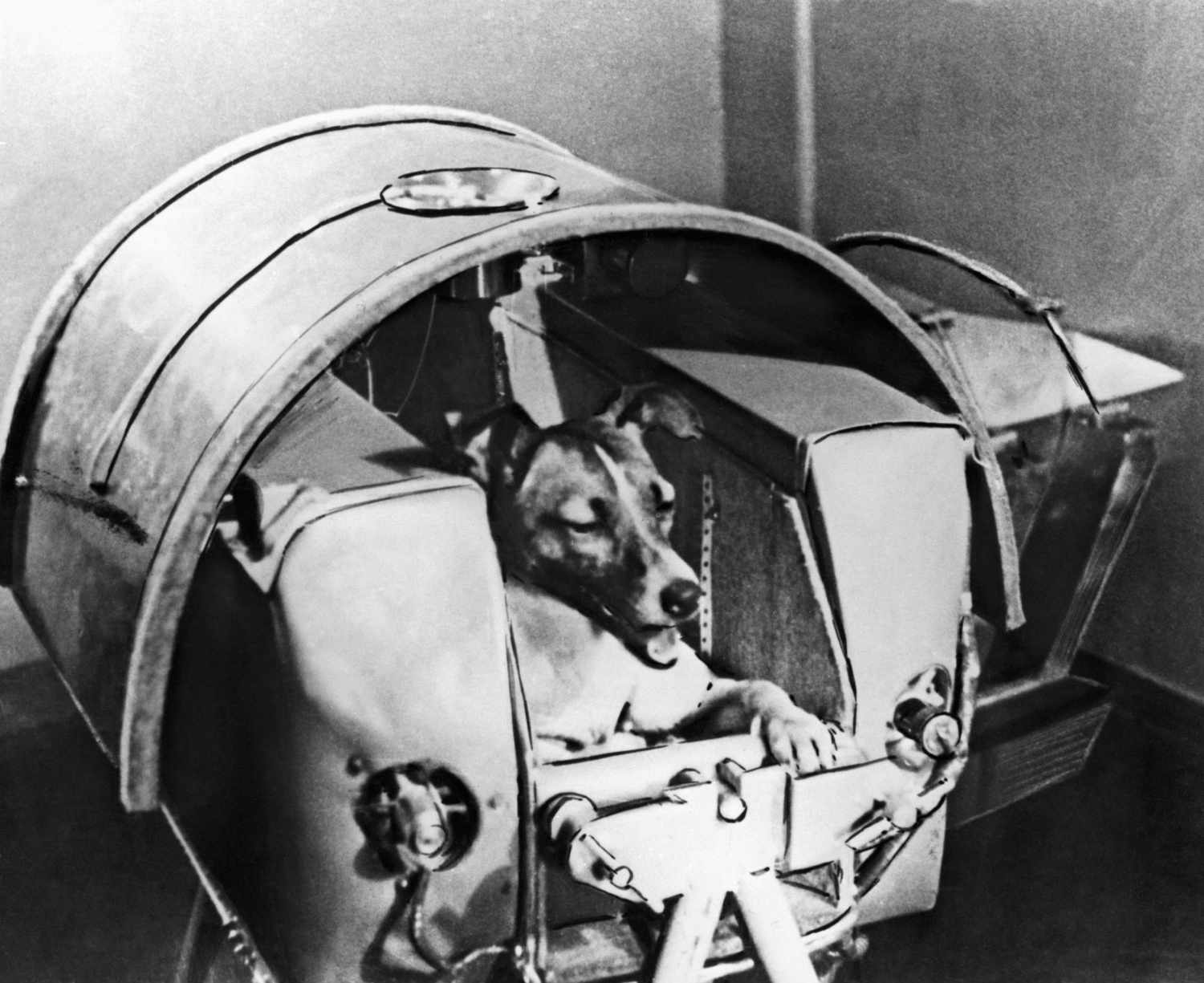
Laika, which means “barker” in Russian, was a three-year-old, stray mutt that weighed 13 pounds and had a calm demeanor. She was placed in her restrictive module several days in advance.
Right before launch, Laika was covered in an alcohol solution and painted with iodine in several spots so that sensors could be placed on her. The sensors were to monitor her heartbeat, blood pressure, and other bodily functions to understand any physical changes that might occur in space.
Although Laika’s module was restrictive, it was padded and had just enough room for her to lay down or stand as she wished. She also had access to special, gelatinous, space food made for her.
Laika’s Launch
On November 3, 1957, Sputnik 2 launched from Baikonur Cosmodrome (now located in Kazakhstan near the Aral Sea). The rocket successfully reached space and the spacecraft, with Laika inside, began to orbit the Earth. The spacecraft circled the Earth every hour and 42 minutes, traveling approximately 18,000 miles per hour.
As the world watched and waited for news of Laika’s condition, the Soviet Union announced that a recovery plan had not been established for Laika. With only three weeks to create the new spacecraft, they did not have time to create a way for Laika to make it home. The de facto plan was for Laika to die in space.
Laika Dies in Space
Although all agree that Laika made it into orbit, there had long been a question as to how long she lived after that.
Some said that the plan was for her to live for several days and that her last food allotment was poisoned. Others said she died four days into the trip when there was an electrical burnout and the interior temperatures rose dramatically. And still, others said she died five to seven hours into the flight from stress and heat.
The true story of when Laika died was not revealed until 2002, when Soviet scientist Dimitri Malashenkov addressed the World Space Congress in Houston, Texas. Malashenkov ended four decades of speculation when he admitted that Laika had died from overheating just hours after the launch.
Long after Laika’s death, the spacecraft continued to orbit the Earth with all its systems off until it reentered Earth’s atmosphere five months later, on April 14, 1958, and burned up on reentry.
A Canine Hero
Laika proved that it was possible for a living being to enter space. Her death also sparked animal rights debates across the planet. In the Soviet Union, Laika and all the other animals that made space flight possible are remembered as heroes.
In 2008, a statue of Laika was unveiled near a military research facility in Moscow.
