


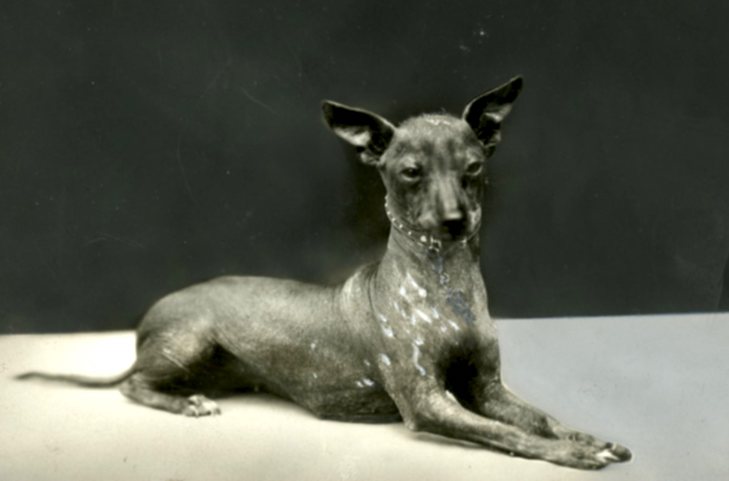
For millennia, dogs have accompanied us pretty much everywhere, from the bush-shaking throes of the hunt to the contemplative crackle of the evening fire. So it shouldn’t be too hard to understand why in some long-ago civilizations, their presence was required on life’s final and most critical journey – to the Great Beyond.
This ancient belief that dogs had the ability to control human access to the afterlife spans continents and cultures. In Egypt, the jackal-headed god Anubis weighed a person’s heart to determine them worthy of entering the realm of the dead. Thanks to Harry Potter, everyone knows about Cerberus, the multi-headed dog of Greek mythology that guarded the gates of Hades.
And among the ancient Aztecs of central Mexico, Xolotl, the god of death, was depicted as a canine-headed monster. He in turn lent his name to the Xoloitzcuintli, a dark-colored, elegant dog that was often hairless. (To pronounce that three-car pile-up of letters, try “show-low-eats-queen-tlee.” Or just know when you’ve been beaten and use the shorthand “show-low” instead.)
Role in Aztec Society
Found in three sizes – toy, miniature and standard – this indigenous Mexican dog was said to have been created by Xolotl from a sliver of the Bone of Life from which all humanity sprang. Given this celestial provenance, it’s not surprising that the Xoloitzcuintli had several high-profile roles in Aztec society, the most critical of which was leading the dead to Mictlan, or the underworld.
Getting there, however, required navigating nine levels with challenges such as mountains that crashed into each other and winds that blew knives. After a process that could take up to four years, weary souls reached a broad and deep river. Awaiting them on those eternal shores – hopefully – were their Xolos, which, on recognizing their masters, would leap into the water to ferry them across.
To ensure they were riverside to complete this vital task, dogs were often ritualistically killed and buried or burned alongside their masters. For those who were poor and didn’t have the means to own a dog, a pottery statue was used instead.
A Canine Hot-Water Bottle
Here in the world of the living, perhaps the most striking aspect of the Xoloitzcuintli is its hairlessness. However, there may be tufts on the top of the head, tip of the tail, and the toes. This unique feature likely led to the belief that the breed has healing properties, is able to sense disease and, sometimes, dispel it by snuggling close, like a canine hot-water bottle. Even today, some Xoloitzcuintli owners say their dogs seem to instinctively know if they’re hurting, and will lie against the affected spot to offer the benefit of their tough-skinned, heat-radiating bodies.
While the hairless variety is synonymous with the Xoloitzcuintli, there are coated Xolos, too. Hairlessness is a dominant trait. Having just one copy of the hairless gene automatically means a dog will be hairless. But in this case, there certainly can be too much of a good thing. Inheriting two copies of the hairless gene means that a puppy will die in utero, a genetic phenomenon known as a lethal homozygote. (The same applies to another hairless breed, the Chinese Crested.)
As a result, the coated variety of the Xoloitzcuintli needs to exist in order for there to be hairless dogs. Coated Xolos have a short, dense coat over their entire body. They also have a normal number of teeth compared to hairless Xolos, which are often missing teeth because there is a genetic connection between hairlessness and lack of dentition.
On the Cusp of Extinction
Aside from dogs, the only other domesticated animal raised by the Aztecs was the turkey, which was a much-needed protein source in a diet that mostly included beans, corn, and squash. Much has been made of the tradition of consuming dogs, though sources conflict about which dogs landed on the menu, and how often it happened. Nonetheless, that custom was much commented on by the arriving Spaniards in the 16th Century.
Given the presence of Xoloitzcuintli in pre-Columbian art and artifacts – and the dog’s prominent position in the Mayan calendar, alongside ocelets and eagles – it’s clear these naked canines were held in great esteem in central Mexico for the better part of three millennia. But their association with pagan culture wasn’t embraced by the arriving conquistadors, whose acquired taste for dog meat almost drove the breed into extinction.
The arrival of European breeds did just as much damage: New World dogs like the Xoloitzcuintli were so overrun with the genetic incursions of their Old World counterparts, from Poodles to Dachshunds, that recent genetic research shows very little of that original DNA remains. By the early 19th Century, the once ubiquitous Xolo could only be found in remote mountain villages.
Resuscitating the Breed
Given the Xoloitzcuintli’s precipitous decline during this period, it’s surprising that it was among the early dogs accepted by the American Kennel Club in the form of “Mee Too,” a Mexican import registered in 1887. But the breed’s numbers didn’t build. In 1940, in a sort of canine last gasp, a dog named “Chinito Junior” became the breed’s first – and, for a very long time, only – AKC champion.
In Mexico, however, the 1910 revolution reignited interest in indigenous culture in general, and these aboriginal dogs in particular. They were embraced by artists Frida Kahlo and Diego Rivera, who were frequently depicted with the hairless dogs both in photographs and on canvas.
Determined to resuscitate the breed, in the mid-1950s a team of dog experts embarked on an expedition into the remote countryside to find surviving dogs. Eventually, ten identifiable Xolo-like dogs were located, and they formed the foundation for the breed’s revival.
More than a half-century later, in 2011, the AKC again formally recognized the Xoloitzcuintli.
Today, the Xolo is being embraced for the same reasons it was rejected by the conquistadors: For being an eye-catching, mesmerizing icon of ethnic identity. Now the national dog of Mexico, the Xolo has become popular among the nation’s hipsters and celebrities. And in 2017, the Pixar movie “Coco” – which stars an animated Xolo named “Dante”– introduced the breed to an international audience.
For a breed long associated with the finality of death, it’s an amazing resurrection.
