


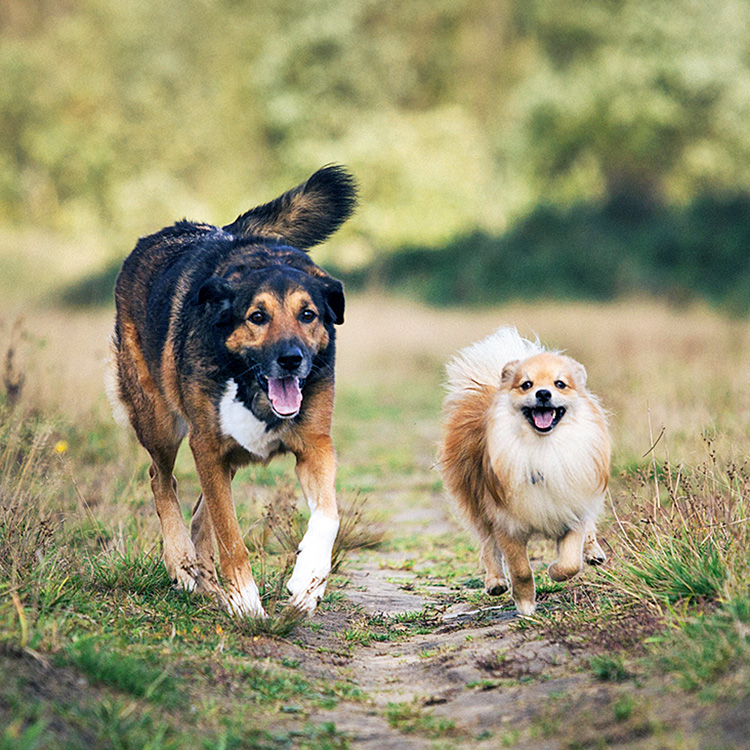
When you look at a fluffy Pomeranian, it’s hard to imagine that the tiny poofball could possibly be related to a fierce wolf — or even a Siberian husky, for that matter. But all dogs share a common ancestor, even if modern breeds truly run the gamut of size, shape, and temperament.
Dogs were some of the first animalsopens in new tab to be domesticated roughly 30,000 years ago, and scientists have long wondered when exactly wolves started becoming the diverse set of dogs we know and love today. A new study published in the journal Scienceopens in new tab reveals that selective breeding might have started in the Middle Stone Age — way earlier than we originally thought.
It’s been a common believe that modern dog breeding began with the Victorian kennel clubs of the 1800sopens in new tab, which formalized different breeds into distinct categories. But even though those kennel clubs might’ve given names to specific canine qualities, different types of dogs existed for many, many years before. And as it turns out, our ancestors had been selectively breeding dogs over 10,000 years ago.
“It’s really surprising,” Dr. Cary Ameen from the University of Exeter, a lead researcher on the project, told BBC Newsopens in new tab. “And it starts to challenge the ideas about whether or not it was the Victorians — and their kennel clubs — that drove this.”
The international research team behind this study looked at prehistoric canine skulls, examining and scanning bones from across 50,000 years of dog evolution. Because wolves and dogs are very similar in appearance, to the point where many modern breeds still strikingly resemble wolves, it can be hard to track the physical domestication of wolves. A new technique called geometric morphometrics — which lets scientists map and measure shapes in three dimension — allowed the research team to analyze subtle changes in the shape of canine skulls.
Dog skulls present a unique opportunity for scientists. While most animal bones from archaeological sites tend to be fragmented and discarded, dog bones are usually better preserved because dogs are often intentionally buried. The researchers were able to create digital models of over 600 skulls and compare features from ancient and modern canines. They found that it was 11,000 years ago, just after the last ice age, that dog skulls began to drastically change shape: In addition to wolf-like skulls, there were a number with shorter snouts and stockier heads.
“By about 10,000 years ago, half of the amount of diversity present in modern dogs is already present in the Neolithic,” Ameen said to NPRopens in new tab. “So very early on in our relationship with dogs, we not only change them from wolves, but they begin to change amongst themselves and generate a lot of diversity.”
Researchers still don’t know why ancient dogs’ appearances began to shift. They can only theorize about a number of factors that may have led to the first distinct breeds. And while one reason might be our human ancestors thinking that wider dog heads were cute, the real answer is probably way more layered.
“It’s likely to be a combination of interaction with humans, adapting to different environments, adapting to different types food — all contributing to the kind of explosion of variation that we see,” said Ameen. “It’s hard to untangle which of those might be the most important one.”
Ameen and co-lead researcher Dr. Halloween Evin of Université de Montpellier penned an article for The Conversation, delineating more about the studyopens in new tab. They concluded that their research needs more specimens, specifically from 25,000 to 11,000 years ago in central and southwest Asia, to deepen their understanding of canine domestication.
“Ultimately, dogs are a mirror of human history,” they wrote. “Their story is intertwined with ours, shaped by shared migrations, changing environments and evolving societies. As the first domesticated species — and still our most enduring companion — dogs offer a unique window into how humans have shaped the natural world and how the natural world has shaped us in return.”
