


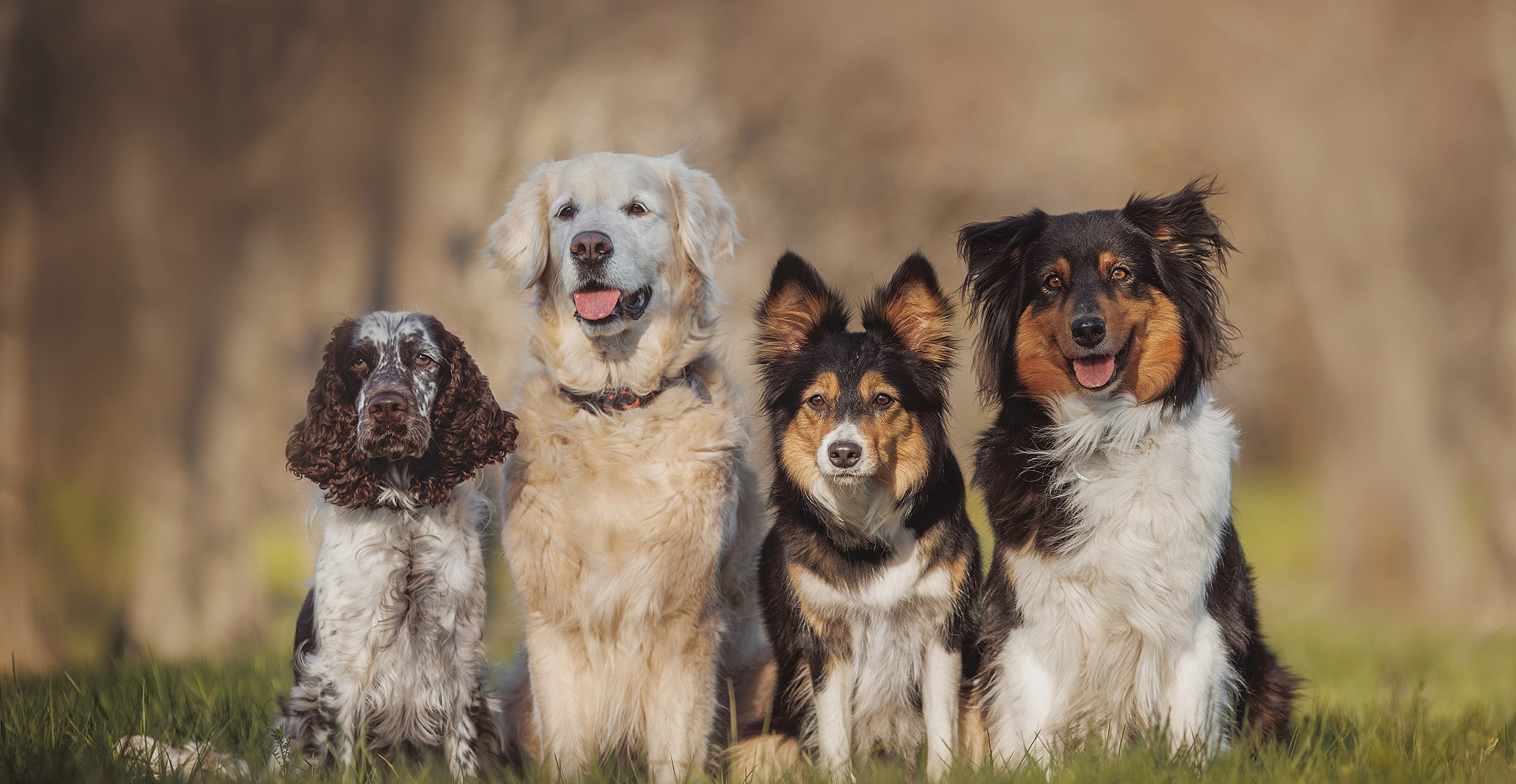
From tiny Chihuahuas to huge Saint Bernards, dogs come in all shapes and sizes! But they didn’t always lie on our sofas and wear Christmas jumpers.
In fact, it’s hard to believe that the ancestors of our beloved pooches were wild animals – wolves. So how did wolves end up living in our houses?
When were dogs domesticated?
Dogs are the earliest domesticated species. However, the exact timing of when this domestication occurred remains unclear and is still being researched.
Evidence suggests that around 30,000 years ago, during the last ice age, a now-extinct population of grey wolves began the process of domestication. Genetic studies indicate that all modern dogs descend from this one common ancestor.
The domestication of wolves took place over a long period of time. Ancient bones roughly 15,000 years old of dogs that we’d recognise today have been discovered in various locations. Although the exact location of where domestication first took place remains unclear, research shows that the earliest dogs migrated across the world alongside humans.
How did wolves become dogs?
The processes and reasons behind wolf domestication are still being investigated. One of the most popular theories is that they domesticated themselves. This is called self-domestication.
Ancient DNA evidence suggests that dogs were domesticated before the rise of agriculture, when hunter-gathers preyed on large animals. Dogs are the only animals that were domesticated during this period – all other domestication happened after farming became widespread.
It’s thought that wolves were drawn to human campsites by the smell of cooking meat and the easy pickings of discarded scraps. Eventually they began to guard the area from predators and even helped with hunting large animals.
Over time, some of these wolves began sticking around, treating the camps as part of their own territory and alerting humans to nearby threats. The friendlier, less aggressive wolves may have been tolerated by humans. Gradually, these wolves became tamer and more reliant on human interaction. This kicked off the self-domestication process, with certain wolves choosing to live alongside humans, and with that a symbiotic relationship was formed.
Another theory is that humans domesticated dogs to help with hunting large mammals. This partnership would have eventually led to mutualistic benefits such as increased nutrition and population growth for humans and decreased risk of injury and death for wolves.
An ancient bond
Once domesticated, dogs became incredibly valuable to human communities. They served as hunters, guards, herders and companions. In hunter-gatherer societies, dogs helped track and retrieve prey, which increased the efficiency of human hunters and allowed them to conserve their energy.
The keen senses of the earliest dogs made them useful to warn against predators or hostile intruders.
Dogs also held spiritual and symbolic roles in many ancient cultures. Archaeological sites have uncovered dog remains carefully placed next to human skeletons, suggesting that the human-dog bond stretches back thousands of years.
The future of dogs
As human societies evolved and diversified, so too did the roles of dogs. Different breeds were developed to perform highly specialised tasks.
Cocker Spaniels were originally bred as hunting dogs to flush out game birds from dense bushes. Sheepdogs, such as Border Collies, were developed for their intelligence and agility to help farmers herd and manage livestock. While in mountainous regions, breeds such as the Great Pyrenees were used to guard flocks from predators.
Today, the UK is home to approximately 13 million dogs. While most are kept primarily as pets, many others continue to fulfil a range of important roles acting as medical detection, police and service dogs.
Over the past 200 years, the majority of modern dog breeds have been developed through selective breeding. However, the process of selective breeding can cause issues for canines. Some of our staff are involved in a study that’s working to identify potential problems.
Dr Lucy Roberts, one of our scientists who’s involved in the research, is examining shape variations in the limb bones of different dog breeds and comparing them to those of their wild relatives.
“Currently, apart from the skull, veterinary care generally treats all dogs like they’re the same, just different sizes. But no one has yet considered if all the breeds are actually the same as each other,” explains Lucy.
“In my work, what I’m finding that’s interesting is that a lot of the bigger breeds such as German Shepherds, Greyhounds and Wolfhounds are more similar to the skeletal shape that we see in wolves. It’s the smaller breeds where we’re seeing these extreme changes in body and bone shape.”
The research project, which draws on information about their wolf ancestors, could eventually lead to better veterinary care for dogs of all shapes and sizes.
So, the next time you see a dog, take a moment to imagine the incredible history behind its wagging tail.
