


You don’t have to speak a word of Italian to understand opera. With a universality that transcends spoken word, its arias plunge a listener into the depths of our most primal human emotions – love and hate, jealousy and revenge.
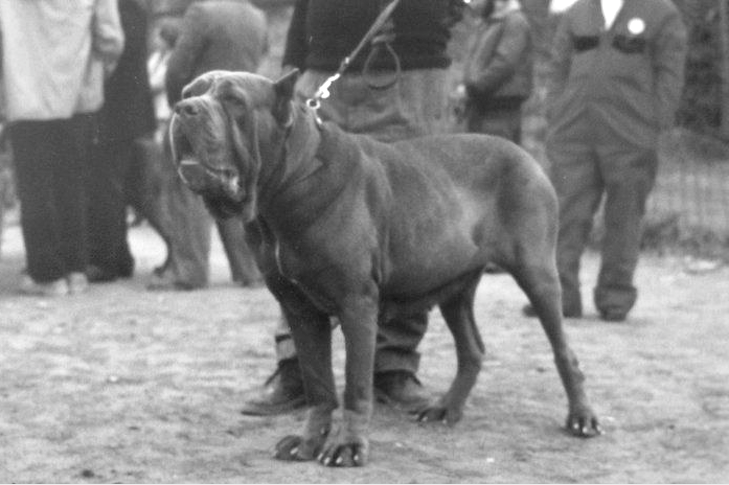
You also don’t need to know anything about dogs to register the similarly strong emotions evoked by the sight of a Neapolitan Mastiff. From their thick, rope-like facial wrinkles to their tree-trunk-sized limbs, this is a dog of unadulterated power and primitivism. In their elastic, lumbering gait, which belongs more to a big cat than a mere canine, there is a sheer bestiality that summons archetypes older than civilization itself.
Described as the most operatic of all the dog breeds, the Neapolitan Mastiff lays claim to the heritage of the famous Molosser dog. That prized canine from ancient Greece was massive in size, with a ferocity to match. They acquired a reputation for striking awe that has endured for millennia. In truth, virtually every heavy-boned, thick-skinned, mastiff-type breed claims to descend from this peerless defender. The difference is, in the case of the Neapolitan Mastiff, that might actually be true.
Do They Descend From the Molosser?
The Molosser arrived in ancient Rome thanks to the expansiveness of Roman culture and the value placed on quality animals, not least of all dogs. The Romans were unapologetic collectors of unusual creatures from the farthest reaches of their empire. Plus, they were skillful dog breeders who produced specific types for different tasks, from coursing to fighting to tracking. Mentioned by a number of classical Roman writers, from Horace to Virgil, the Molossers were believed to have accompanied the Roman legionnaires as war dogs, showcasing their fighting skills in venues as spectacular as the Coliseum.
Like all great empires, Rome eventually fell. However, its grand architecture survives to this day, with crumbling temples and aqueducts providing ample fodder for the smartphone lenses of tourists. Whether the Neapolitan Mastiff is another of the empire’s many achievements to survive for millennia is harder to decipher – and perhaps it really doesn’t matter. Even if the Neo isn’t a proven descendent of the Roman war dogs of old, they certainly look the part.
The Valued Guardian of Naples, Italy
The Mastino Napoletano, as they’re known in their homeland, is named for Naples, two and a half hours south of the Eternal City. Sitting sentry in cobblestoned courtyards, they were a valued guardian who could be relied on to repel intruders by simply raising their heavy head from atop their massive paws. The mastino was built for short bursts of speed. They had just enough range to reach anyone with ill intent and the foolhardiness to attempt to exercise it. In the countryside, the Neapolitan Mastiff guarded farm and flock with as much dedication as he did the entryway to an estate.
But the relentless push of modernity, not to mention the devastation of World War II, posed an existential threat to this living gargoyle. This breed has survived an altogether different kind of war in the form of deprivation and starvation, which almost led to its extinction.
In 1946, Italian dog fanciers held their first postwar dog show at the Castel dell’Ovo, or “Egg Castle,” a seaside fortress on the Gulf of Naples. Eight “cani da presa,” or “catch dogs,” as Neos were known, were exhibited there. The dogs ranged in color from blue to black to brindle to gray. While the judges were largely unimpressed with the dogs before them, the Swiss fancier and journalist Piero Scanziani was smitten by one dog in particular. Known as “Guaglione” – which means “kid” or “guy” in the Neapolitan dialect. This “blue, mighty” dog evoked for Scanziani the ancient Molosser, staring at him “from this height of centuries past.”
Scanziani eventually acquired Guaglione. He rented space at Rome’s zoo for his breeding program, which focused on accentuating the wrinkles that Guaglione admittedly didn’t have in abundance. Nonetheless, Guaglione became the first registered Neapolitan Mastiff and the breed’s first Italian champion, and served as the model for the inaugural breed standard.
Only a handful of years later, the Neapolitan Mastiff took a stratospheric leap forward with the arrival of Mario Querci. A textile maker from Tuscany, Querci applied his knowledge of how fabric drapes to standardize the breed’s definitive facial wrinkles, mandating the folds that fall from the outside of the eyelid to the dewlap at the throat, as well as from the lower lids to the outer edges of the lips. Querci acquired very rustic breeding stock from Naples – the so-called “zaccaro” type dog, which was heavy in bone but low on leg – and added a degree of elegance and soundness. The apex of his breeding program was arguably “Caligola di Ponzano.” They won the World Dog Show in Valencia, Spain, in 1992, besting some 6,600 dogs of all breeds.
Today’s Neapolitan Mastiff
After that golden age of Querci’s Ponzano dogs, the Neapolitan Mastiff arguably lost its way for a time, distracted by the breeding version of a baccanale that would’ve done Caligola’s namesake proud. Adopting a more-is-more philosophy, some breeders bred for an abundance of loose, flaccid, overly wrinkled skin, and focused less on the overall soundness of the dog. But after a concerted international effort at a course correction, today’s Neos have largely moved away from such extremes, focusing on health and soundness as much as wrinkle.
Despite its long presence in Italy, the Neo was only recognized by the American Kennel Club in 2004. Given the demands of dealing with such a large, protective dog that produces drool the way some Labradors retrieve tennis balls, the breed is hardly commonplace. The most likely place to spot one is on a televised dog show, where the Neo invariably provokes loud cheers. Alternately, there are the “Harry Potter” movies, where a Neapolitan Mastiff played the dog belonging to Hagrid the gamekeeper.
Though Fang was originally described in the “Harry Potter” novels as an oversized black boardhound – so, arguably, a Great Dane – the casting of a Neapolitan Mastiff in J.K. Rowling’s wizarding world was inspired. The ancient themes that swirl around the Forbidden Forest remind us that that which is real isn’t always readily seen. But for those who look beyond the Neapolitan Mastiff’s imposing exterior – and especially the loyal, intuitive, ancient soul beneath – already know that all too well.
